Showing posts with label Deadwood. Show all posts

Tuesday, December 23, 2008

Welcome to *^&@ Deadwood and The Wire on DVD!

Mo Ryan's comment in the previous entry about Amazon selling "The Wire: The Complete Series" for $89.99 (64% off the retail price) was a good enough pointer that it deserved its own post (even though Amazon's temporarily out of stock, it's a hell of a deal if you don't mind waiting), especially since Amazon also has "Deadwood: The Complete Series" for $74.99 (58% off).

With "The Wire," you're largely buying it if you don't already have the previous DVD sets, as the only notable new features are the three prequel films (with Young Omar, Young Prop Joe, and the first meeting of McNulty and The Bunk) that were made before season five, plus a gag reel. But that's a great price for the single greatest drama in TV history, and even if there were no special features, I'd want to own it if I didn't have the season-by-season sets.

"Deadwood," on the other hand, has an extra disc with brand-new features, which I'll talk about after the jump...
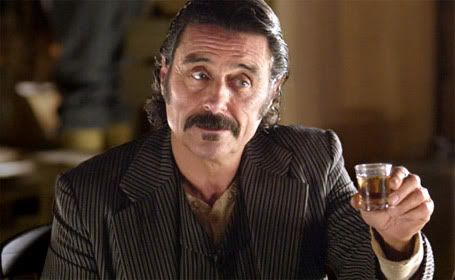
"The biggest lie is the idea that we are entitled to a meaningful and coherent summarizing, a conclusion, of something which never concludes. In that regard, this is the lie I'm telling myself so I don't set fire to anything." -David Milch
That quote's from the highlight of the bonus disc, in which the creator of "Deadwood" tours the old sets and talks about where he might have taken the show in the fourth season, or in the movies that are now never going to be made.

I know a lot of "Deadwood" fans still blame Milch for bringing the show to a premature end, even though everything I know about the situation says that Milch was the fall guy in a financial dispute between HBO and Paramount, and that the whole "He was so excited to begin work on 'John From Cincinnati' that we had to put 'Deadwood' on hold" was a lie agreed upon so that at least Milch could have something on the air where he could employ a lot of the "Deadwood" cast and crew.

But regardless of your feelings for Milch and whatever role he played in the show's sudden demise, there's no denying his passion for the project as he walks through the ghost town, admits to feeling depressed being there, and does one of his patented stream-of-consciousness monologues about the nature of endings. (See above.)

The Milch featurette makes a wonderful double feature with one of my favorite DVD bonuses of all time. Titus Welliver, who played Al Swearengen's protege Silas Adams, turns out to be a brilliant mimic, and he tries to imagine Milch meeting with various classic '70s actors (Pacino, DeNiro, Walken, Duvall) to see if they would want to play Swearengen. Even though Welliver is in full "Deadwood" costume, complete with beard, he nails all five impersonations, particularly Milch's crooked posture and leisurely syntax. It's hysterical.

There's also a half-hour feature on the real Deadwood, a tour of the set, and an hourlong conversation with the cast and crew from 2005. Plus, the packaging makes the whole thing roughly the size of any of the single-season sets, which is good for those of us with limited shelf space.

Christmas is almost here, but if you need a last-minute gift idea for the TV lover, here you go.
Click here to read the full post

Thursday, July 10, 2008

If there's full-frontal male nudity, it must be HBO

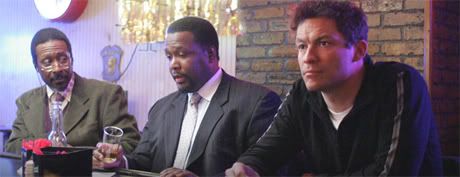
I always seem to wind up entering press tour at a, um, colorful moment. At my very first session of last summer's tour, Sarah Silverman told me to go bleep myself (she was kidding, I think), and the first image to greet me upon my arrival at this summer's tour was two very muscular, very naked, very silly-looking men (see above) being more affectionate than they perhaps realized.

This was a clip from "Little Britain," the popular British sketch comedy series that's arriving on HBO (with all new episodes, produced in America and directed by Michael Patrick Jann from "The State" and David "Ross" Schwimmer) in late September. Needless to say, it got my attention.

The "Little Britain" session was the next-to-last of the day -- HBO is paneling the Alan Ball vampire soap opera "True Blood" as I type this -- so I'm still playing catch-up. Among the things I missed today while I was in the air:
  • "Little Britain" HBO will debut on Sunday, Sept. 28, at 10:30 p.m. It'll be following new episodes (and hopefully funny ones, though based on the last few seasons, I'm not optimistic) of "Entourage," which will be back on Sept. 7, along with the debut of "True Blood."
  • I've been saying from the day that HBO canceled "Deadwood" that I would believe the proposed wrap-up movies would get made the day the review screeners crossed my desk. Looks like that's never going to happen: HBO co-president Richard Plepler told the critics, "I think it's safe to report that the likelihood of Deadwood (movies) happening is slim to none."
Maybe more later tonight as I get acclimated, and I hope to hit the ground running first thing tomorrow. Click here to read the full post
Wednesday, March 05, 2008

These are the Daves I know: The Wire vs. The Sopranos vs. Deadwood

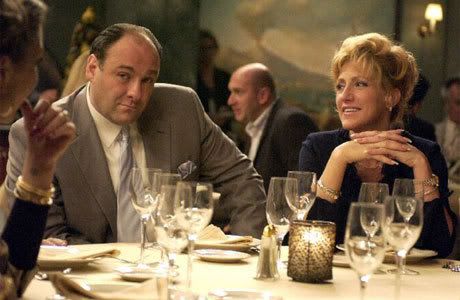
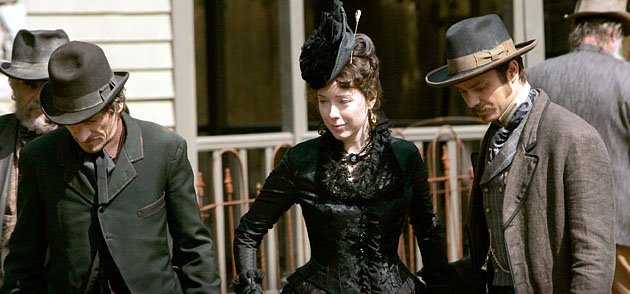
Over the weekend, I got together with my old partner Matt Zoller Seitz and Andrew Johnston from Time Out-NY to debate -- politely -- about the relative supremacy of "The Wire" (my horse), "The Sopranos" (Andrew's pick) and "Deadwood" (Matt's). It was recorded as a podcast and you can listen to it (and, briefly, download it) over at The House Next Door.

Feel free to discuss anything that comes up in the podcast, or any other arguments about one show vs. the others, but do not attempt to slip in spoilers for "The Wire" series finale. I understand it's already leaked on-line, and if I so much as smell something that's either an obvious spoiler or something that seems like a spoiler but is dressed up as a really clever guess, we're going to comment moderation -- on the entire blog -- from now until Sunday night. You feel me?

UPDATE: Matt has added a transcript for those who were having technical difficulties with the podcast -- or who just hated the sound of clanging dishes in the background. Click here to read the full post
Wednesday, August 15, 2007

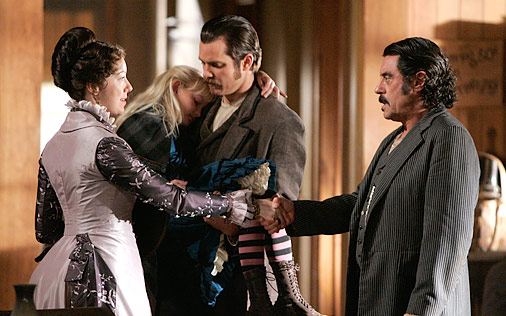
Fur is big. Bill Clark is big. Deadwood may be small.

In case you missed it on the comments to the "John From Cincy" finale post, HBO has, not surprisingly, pulled the plug on the adventures of Butchie, Cissy, Freddy, Palaka-y and the rest. Meanwhile, HBO has signed David Milch to a development deal.

But even though Milch is both freed from "John" and signed to stay with HBO, I don't think the "Deadwood" reunion movies are any closer to reality. This story in Variety says that the first project he hopes to work on is another Bill Clark-inspired cop show, this one a period piece based on Bill's experiences coming home from Vietnam and being recruited by the NYPD to go undercover in the anti-war movement of the early '70s. It's an idea Milch has had in his head for a while (I remember him telling me about it shortly after the first season of "Deadwood" ended), and the premise is far enough removed from "NYPD Blue" that it wouldn't feel like a retread. (Plus, Milch's writing style has changed quite a bit since those days.)

As for the "Deadwood" movies, I just think there are too many logistical hurdles for them to ever happen. The cast is huge, and while "John" showed that Milch can get a lot of the supporting players if he wants them, Ian McShane has been working non-stop since "Deadwood" ended, Molly Parker's committed to a new series (CBS' "Swingtown," though who knows how long that'll last), Tim Olyphant seems focused on his suddenly-thriving movie career, etc. Finding a window when all of these people will be available, not to mention reconstructing all the sets that were dismantled and/or sold, just seems impossible to me.

I've said before and will say again that "John" shouldn't take the blame for the demise of "Deadwood," as it was really HBO's alibi for cancelling an acclaimed but prohibitively expensive show. ("You see, we would've loved to keep 'Deadwood' around forever, but David had this idea about surfers, and he was really excited, so...") But once they let all the actors out of their contracts, that effectively killed any future movie prospects. This isn't the kind of thing where Milch can grab three actors and film it in his basement, you know?

Over at Time, James Poniewozik thinks he'd rather see Milch do something new, anyway, and I can see some merit to that. Even though it wasn't intended that way, the season three finale worked surprisingly well as a series ender, I thought. I would never object to more Al Swearengen, but I don't think we're ever going to get it, and I'm okay with that. Click here to read the full post
Sunday, August 27, 2006

Deadwood: Final curtain

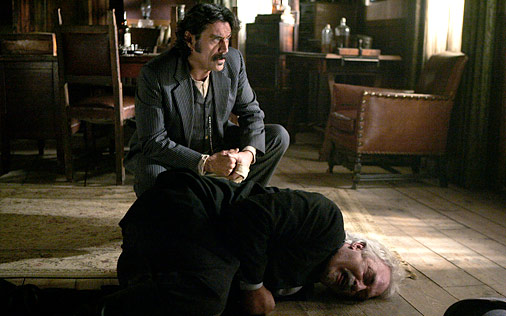
When I got done watching the "Deadwood" finale, my initial thought was "good season finale, an absolute joke of a series finale." The more I thought of it, though, the more I realized that maybe there was more closure than Milch intended. Either way, I'm depressed that one of the best TV shows of my lifetime is over, probably never to return. (I believe the movies will happen the same way I believe Isiah Thomas is building a championship contender at MSG.) More after the jump...

So let's see: Hearst is gone, the camp is spared destruction by the Pinkertons, Alma sold her mine so she could stay in camp, and Seth is going to lose his badge thanks to Hearst and Jarry's vote-tampering. That's a fair amount of significant threads tied up, albeit many of them happening in the last 15 minutes or so. So what was left unresolved, and what were the odds Milch was going to deal with them in the mythical season four? In no particular order:
  • Where is Joanie and Jane's relationship going? The whole thing was both slow-building and sudden (took Milch forever to inch up to it, and then when he did it was quickly a full-on romance, or the closest thing Jane is capable of), and while they ended the season on a relatively happy note, I think there were interesting roads this could have traveled. Would Milch have eventually gone back to the history books and had Jane become a whore, possibly to spite Joanie? How would Joanie manage to stay out of the legend of Calamity Jane? Etc. (On a side point, Charlie giving Joanie Bill's coat for "you and the other one" answers my question from earlier the season about whether he knew Joanie was a lesbian.)
  • Why oh why oh why did we spend so much time with Langrishe and his theater company? You could argue that Milch was setting the stage for a lot of more significant theater stuff in year four, but I'm not so sure. That scene with Jack and Claudia where he lamented an actor's usefulness in the midst of such real-life drama as the camp was facing sure sounded to me like a meta comment on the value (or lack thereof) of these new characters. Then again, Milch rarely seems interested in going meta, so maybe not. Frankly, losing the chance to find out what's up with Jack, Claudia and the two mystery women won't be keeping me up at night.
  • What's eating Cy Tolliver? Okay, in this particular case, it was pretty clear: he was hoping his partnership with Hearst would lead to lavish criminal endeavors and the chance to kill or crush his enemies, and instead he became just another cog in the mining operation. Still, it felt like Cy outlived his usefulness a long time ago -- maybe not a surprise, since the character only existed because Milch felt bad that Powers Boothe was too sick to play Swearengen when the pilot was filmed -- and he spent most of his seasons being irritated at how marginal he had become. Hell, maybe Milch really does like writing meta, after all.
  • Odell's death and the Earps, two plots that popped up mid-season, didn't really go anywhere and then stopped abruptly. I doubt we would have seen Wyatt and Morgan again, and with Hearst on his way to Montana, would Aunt Lou be following, or would she be one of the people Hearst left behind to keep an eye on his interests (in this case, how E.B. runs the Grand Central)? And would she even be willing to work for him anymore? I suppose Lou might have become yet another member of this sprawling supporting cast in season four, because the show already didn't have enough characters to service. But I doubt we ever would have found out what Odell's game was, any more than we found out what Wyatt's genius plan was.
  • Is the Doc really dying, or is he just a hypochondriac with a bad cough? Not sure if Brad Dourif had other commitments that kept him away from the set a lot this season, but I felt like Doc, Sol and Adams suffered the most in terms of screen time sacrificed to new characters and concerns. I can only hope Al's "Get busy living or get busy dying" speech would have continued to keep Doc upright and active through the final season.
  • What does Ellsworth's death mean for Seth and Alma -- and, of course, Martha? This could have been one of season four's most interesting subplots: how does Martha balance her innate decency and selflessness with the knowledge that her husband is spending more time with his ex-mistress?
  • Whither The General and Steve? Ehhh... I love Franklin Ajaye in this role but could live without more of this odd couple.
  • What will Harry Manning be like as sherriff? I actually find it a bit sad that he won, not because Seth is out of a job that he didn't really want, but because the only reason Harry ran was to get enough attention to become a fireman. Tom went and bought the firefighting equipment, and now Harry's going to be stuck policing the camp when he'd rather be polishing the fire wagon. Still, I think I'm okay not seeing where this goes.
The most important question: what did the future hold for Al, Seth, The Gem, Sol, etc.? Well, you can find out the reality of what happened to most of the major figures here, and I suppose if the movies actually do happen, they would tackle a lot of this. But even though the fire was technically the end of the camp, I feel like we reached a good thematic end with Hearst's arrival and departure. After all, the show has always been about how civilization is born of chaos. We've seen the imposition of law & order and with the successful (albeit rigged) elections, the camp's assimilation into the United States is a fait accompli. And once you bring order to a lawless place, all that's left is for those with the most money to start swinging their weight around to prove that the law doesn't apply to everyone equally.

So we have greed and wealth (Hearst) triumphing over the rule of law (Bullock), common decency (Ellsworth) and even our famous Yankee cunning and know-how (Swearengen). (Warning: liberal political commentary ahead; skip to the next paragraph if you think I'm a commie pinko.) I know Milch and our Commander-in-Chief were frat brothers, but this scenario feels eerily relevant to our current socio-political situation. As David Simon from "The Wire" likes to say, unfettered capitalism is not a social program, and Hearst represents capitalism in its purest, bleakest form.

We all knew that evil was going to triumph to some degree, in that Hearst's survival and later ascendancy to the U.S. Senate is the kind of historical fact that Milch wouldn't fudge (as opposed to, say, Bullock's family situation), but what was surprising was what a rout evil accomplished. For all of Al's plotting and maneuvering over the last half season -- the stuff with Wu and Hawkeye and the editorial and even Alma's walk to the bank -- Hearst got virtually everything he wanted. Ellsworth is dead, Bullock is out of a job and all of Deadwood's gold claims belong to him. I've said that I wasn't expecting any significant gunplay, but at the end all of Al's scheming feels like just another narrative dead end like Odell and the Earps. Really, the only thing Al accomplished was preventing his people from giving Hearst any justification to have his men start a massacre and burn the camp to the ground. And even that came with the pricetag of two bodies: Ellsworth and Jen.

When Matt's review is up, I'll post a link to it here, but he had a big problem with the death of Jen -- or, rather, the lack of any opposition to it besides Johnny. I can see how even Bullock would be conflicted about the choice between an unknown innocent whore and his best friend's guilty woman, but I would have liked to see some arguments about it, or at least some more obvious internal wrestling by some of the "good" guys (if that term fits any living character on this show) than this. It also would have helped if Jen had been more of a known entity to us. I can barely remember her outside the incident with her and Morgan Earp, which in retrospect was supposed to be a hint that Johnny was sweet on her but at the time just seemed like a sign that Johnny was growing up into a true henchman like Dan.

But even within the all the bumps and wrong turns and whozawhuzzahowzahuh? moments, there was still plenty of room for reminders of the genius that's kept us all so riveted to this show for the last three years: Johnny explaining the meaning of the wall to Jen; Farnum's rant about Hearst and "oozing, gruesome goo!"; the look on Harry's face when Tom shows him the crate; Aunt Lou helping Richardson get dressed to cast a spite vote against Hearst; the troublemaking drunk from the No. 10 quoting the 15th Amendment at the Pinkertons; Al's "Play the lie as mine, knowing I speak of you in Heaven" speech to the troops; every word, look and gesture to come from both Gerald McRaney and Ian McShane; and, of course, one final shot of Al scrubbing blood (the symbol of how, yet again, civilization is built on acts of violence) off his floor.

If that's not the most fitting image to end the series on, I don't know what is.

For the last time (sigh...), the lines of the week:
  • Charlie to Hearst: "I'm the guy that, the next time you see me, you better take a different fucking tone with."
  • Hawkeye to Adams: "I came to camp to tell you, but I fell one saloon short."
  • Hearst to Seth: "You mistake for fear, Mr. Bullock, what is, in fact, a preoccupation. I'm having a conversation you cannot hear."
  • Con to Joanie: "I got 'stay the fuck out' written on a stone tablet in my bedroom"
  • Johnny to Jen: "On the surface, yes, it is (a wall). But inside, many creatures go about their lives, such as ants. They got a whole operation going. Soldier ants and worker ants and whore ants to fuck the soldiers and the workers. Right inside that wall, baby ants. Everybody's got a task to hew to, Jen. You understand me? Jesus Christ, fucking sake. We'll talk about this later."
  • Charlie to a Pinkerton: "If he don't make it, you'll be eating your spuds running till I hunt you the fuck down."
  • Al delivering the final line: ""Wants me to tell him something pretty."
And, finally, because it wouldn't be a "Deadwood" farewell without it: cocksuckers!
Click here to read the full post

Monday, August 21, 2006

Deadwood: But does she get a set of Mardi Gras beads?

Serious "Deadwood" spoilers after the jump...

First of all, Trixie's botched hit on Hearst shows the perils of nude assassination. If she'd just gone topless, she might have been able to aim better and do more damage with her teeny purse gun, but she had to go a step too far by lifting her skirt and trying to distract Hearst with her answer to the carpet/curtains question. (Question for the gallery: did Trixie have more than distraction on her mind when she popped her top? She's been fairly respectable for the last two seasons; was there a part of her that felt she had to look like a whore again before doing such an extreme, illegal act?)

Second, let's all hang our heads in a moment of silence for our pal Ellsworth. In his honor, I present the first, and arguably best, of the show's profane monologues:
"I may have fucked up my life flatter'n hammered shit, but I stand here before you today beholden to no human cocksucker, and holdin' a workin' fuckin' gold claim, and not the U.S. government tellin' me I'm trespassin', or the savage fuckin' red man or any of these other limber-dick cocksuckers passin' themselves off as prospectors had better try and stop me."
Poor damn Ellsworth, sweetest man in the Black Hills (the above speech excepted). He's happy to be Alma's beard (and to let Sophia touch his own) and he has to die because Hearst was in a snit that no one rose to his bait last week? I should've known he was in trouble as soon as he began that monologue to the dog (ala Steve's speech to the horse what kicked him), or even last week when Alma started displaying genuinely wife-ly feelings towards him, or hell, when Hearst and his goon started talking about tents, but the shooting caught me unawares. And Gregg Fienberg's decision to use the corpse-eye-view camera to show Alma's reaction was just devastating.

What Hearst doesn't get -- what he'll never get, at least Milch's interpretation of him -- is that every time he tries to scare the citizenry, he only brings them closer together. A couple of years ago, Al killed Alma's husband and tried to kill both her and Sophia; now he's her port in a storm. Ellsworth's death has turned Charlie into drinking buddy with Dan and Johnny, had the guys helping Jewel up those damn steps, had Aunt Lou send over a sympathy basket (and can she start putting some freaking grinded glass in Hearst's food already?), made allies of Sol and Al (who have always been uneasy around each other because of Trixie), and brought the best out in the Doc. (The scene where he explained to Alma the import of Sophia getting to see Ellsworth's body was a thing of beauty.)

And meanwhile, ol' George stands around, barely slowed by the bullet wound, whining about how "I was not made to crush my own kind." Poor, poor baby. And great, great Gerald McRaney, who scared me about 17 different times in the episode, most notably when he sent Langrishe scurrying into his room. Given the historical straightjacket Milch has to write in, can this season end with anything more than Hearst deciding on his own to get the hell out of town? Do the reinforcements provided by Wu and Hawkeye (who I'm guessing is going to prove Al very, very wrong) lead to a full-on battle, or just a stalemate. Or do we, for the love of God, end this "season finale" (one of the phoniest uses of that phrase I've ever seen) on a cliffhanger?

Some other random thoughts:
  • It's hard to look at the scene where Seth hugs Sophia and Alma and not think about what might have been. Poor Martha. Every time it looks like she has all of Seth's heart, some tragedy has to befall the other woman in his life to distract him.
  • Pick a theory for why Cy had a hissy-fit with his whores: 1)He thought Hearst had hired bare-breasted Trixie for a quickie and was annoyed that his fancy-dressed women were passed over; 2)He thought Hearst was dead and was mad that he backed the wrong horse; 3)He saw Ellsworth's body and realized that Hearst was prepared to kill anyone and everyone in camp -- including Cy himself; 4)Like last week, he's just mad at feeling left out of all the action to hang around with his whores and Leon and Con.
  • Good of E.B. to grow a pair and all, but why would Al or Seth or anyone else want the two-faced weasel around for any kind of discreet strategy session?
  • Not since Spider-Man and Superman met for the first time have I been so excited by a cross-universe team-up like the one between Jewel and Richardson.
  • Richardson also had the one saving moment of the usual time wasting with the theater company, when he introduced himself to Claudia by reminding her that he juggled on Amateur Night. I've said it before and I'll say it again: as a foil/sidekick to Al, Langrishe has been a great addition, but as emcee of this pointless group of actors, he can't get out of town fast enough. (Though here's another case where history gets in the way; Jack was apparently a Deadwood fixture for years.)
  • Duck, duck, duck... Goose! Just thought it had to be said.
  • Line of the night: "Wu big man!" Had to smile for the guy having his moment. Though did I miss the explanation for why he's stopped dressing American?

One more episode. I can't believe it -- especially since I'm skeptical that the movies will ever happen. Sigh...

What did everybody else think?

Click here to read the full post

Tuesday, August 15, 2006

Deadwood: The rug really tied the room together

It was the best of "Deadwood" (Al being Al again), it was the worst of "Deadwood" (every scene with Langrishe). It was the age of wisdom (Al figuring out Hearst's game), it was the epoch of foolishness (Hearst sending a henchman alone into Al's lair). It was... ahh, before I do my umpteenth hackneyed riff on "Tale of Two Cities," let's go to the jump for the real observations, shall we?

It's amazing to me how one episode of "Deadwood" can seem so tight and yet contain so much filler. So let's get the latter out of the way as quickly as possible so we can tend to the chocolatey goodness.

First, I never want to see any of the theater people again, and I think that may include Langrishe. Brian Cox is a great, great actor and has been a fun foil for Al, but by God what was the point of the scene with Jack's two women? I'm assuming the dancer is his daughter and the painter is a former lover... or maybe they're both daughters... or they're his sisters... his daughters... his sisters... Whatever the bleep they are, I could not give a good damn about any of it, or about Con's blood flow problem with Claudia, or whatever the hell Bellegarde's going to be doing when we see him next (and here I thought Dennis Christopher had a lifetime pass with me thanks to "Breaking Away"). David Milch is a grand, grand thinker, but sometimes his eyes are bigger than his stomach, you know? I can rattle off a half-dozen "NYPD Blue" story arcs off the top of my head that began with great promise -- or, at least, sounded great when Milch described them -- and then never went anywhere because he got distracted by other things. (In a couple of cases, the stories never even happened at all outside of some interviews Milch gave.)

At first, I was willing to indulge the arrival of the theater company, even though it meant less time for characters like Sol and Adams, because of Cox. Then I was willing to indulge them some more because of all the talks Milch has had with Matt about the nature of drama as a mirror for life and how the theater company's arrival would be the culmination of that theory. Then I was willing to indulge them just a bit more because I made myself forget about all those other Milch digressions to nowhere. But no more. I'm not saying there isn't a point to the theater stuff. There just isn't enough of one to justify this much screen time devoted to them, especially at the expense of an ensemble that was already too full by at least a third.

More randomness: Cy bitching out Janine from Cincinatti, which has to be one of the weirdest in-jokey plugs I've ever seen (assuming it was even meant that way, as opposed to Milch -- or W. Earl Brown, who's the credited writer of the script, even though I'm sure it went through several dozen Milch polishes -- having Cincy on the brain when the scene was being written). I get that Cy has been cut off from most of his usual punching bags (Eddie and Andy are long gone, Joanie's on the side of the angels, Leon's high all the time and Con's too stupid to bother with) and has been reduced to mocking the new whore's name, but still -- too long.

There was some good randomness, however, notably the whores at The Gem (and Jewel) all developing girl-crushes on Alma. Those fit in not only with the episode's depiction of her as heroic for being willing to make the second walk solo, but with what I imagine her real image in the camp would be. She's not a whore, not a schoolmarm, not a vulgar cross-dressing drunk. She's a beautiful, impeccably dressed, well-mannered independent woman who happens to be the second-wealthiest person in town. Of course the whores are going to be impressed by her -- especially since they don't know about the drug problem, or the general haughtiness, or the infamous gift basket scene from season two.

And those bits were only a tiny bit of the genius in "A Constant Throb." Howzabout Al leaping off the freaking balcony to rescue Alma? Or that entire final scene at the Bullock dinner table, with everyone trying very hard not to provoke Seth? (Though, if this episode takes place the day after the Amateur Night, as Jack suggested, how does Bullock make the close to 30-mile round trip ride to and from Sturgis in less than a day? Or am I underestimating horsepower?) Or Adams standing up to Al on the Hawkeye issue? Or Jarry, having just been accused of being gay by Hearst, kneeling down in front of Hearst's crotch to beg forgiveness? Or Dan explaining the facts of life to a trussed-up, raging Ellsworth? Or Alma talking Ellsworth down off the ledge (and, at the same time, maybe realizing that she feels more than affection for him)? Or, hell, even Jane's dream monologue to Joanie, one of those moments where I didn't quite get all the words but understood the melody?

But, obviously, the highlight was Al getting the upper hand on both Barrett and Hearst. If ever a character on this show has been in need of a prolonged beat-down, followed by a throat slash, it's the head brick. In addition to all the sins Al recited, he's also the one who shattered the foot of the salesman -- who, as Doc explained in passing to Cy, is going to lose his leg for the simple sin of calling "No cutsies." (At least, I think that was Barrett; if not, he was the one who orchestrated crap like that, and still deserved the beating.) I loved Al turning the tables on Hearst, who had played on Al's overconfidence with the whole smashed finger incident early in the season and now felt so secure in his position that he sent his top gun into the lion's den with no protection and no witness. Al's taunting of Hearst on the balcony -- particularly the "How's your back?" -- was just an aria of smack talk.

As I've said in the past, I'm going to be damn curious to see how Milch resolves this without turning the finale into Gunfight at the O.K. Corral (minus the departed and pointless Earps).
I just hope like hell that there is a resolution -- at least to the Hearst situation, if not to every story and character thread -- and that Milch didn't just leave everything hanging in the belief that he'd actually get to do the promised fourth season.

Sorry for the multiple delays yesterday. What did everybody else think?
Click here to read the full post
Monday, August 07, 2006

Deadwood: Children's hour

Thoughts on kids in the thoroughfare, homicidal baritones, Richardson's finest hour and all things "Deadwood," after the jump...

"Innocence" isn't the first word that usually comes to mind when thinking of this town and its inhabitants. Hell, it's probably not in the top 100. But in two beautiful sequences, "Amateur Hour" powerfully demonstrated that, while the show focuses on the cutthroat action taking place behind the scenes, the camp at large has plenty worth saving from Hearst and his Pinkerton goons.

The first was the children's walk from their old school to the new one, which incorporated just about every living character on the show at some point. Swearengen, Cy, Hearst, the Pinkertons and the rest were all forced to stop , even for a few moments, and consider a world that isn't ruled by violent self-interest. And folded in there were some lovely small moments, like Alma and Seth sharing a friendly greeting absent any kind of sexual undertone and Jane putting aside her latest bout of self-loathing and whatever fear she may have about her relationship with Joanie so she could be there for the kids.

The second was the event that gave the episode its title. As the camp approaches some very dark times, Langrishe not only found a way to ingratiate himself into the community (as Matt wrote, what better way to flatter your audience than to treat them like the stars for a night?), but to offer almost everyone a distraction from the trouble that Hearst and the Pinkertons are clearly planning. The "almost" couldn't include everyone, of course. Cy had no place at such a positive, wholesome gathering, and with the Bella Union no doubt empty (lot of whores in that audience), he went off to try to make trouble for Joanie. Al, as we learned, has a fine singing voice, but his reputation in the camp wouldn't abide him performing for anyone but the moose's head. (Though, since he already had the severed head thing going, why not bring out his pal the chief? Two heads are better than one, you know.) The suddenly level-headed Bullock, having made one concession in walking Martha and the kids, had to plan for whatever's coming. And Farnum was there in body, if not in spirit, ruining the evening's highlight because he was jealous of the applause his punching-bag Richardson was getting for his juggling act.

If so much of this season has been about people sticking to the rules they or others have written for them, then this episode also featured some exceptions to that. Farnum has treated Richardson as barely a step above a monkey, yet Aunt Lou is kind to him and not only is making a passable kitchen staffer of him, but used him as a crucial shoulder to cry on after getting the awful news about Odell. (Gerald McRaney was just ambiguous enough in the scenes with Lou that, while I'm pretty sure Hearst did Odell in, I'm not positive.) And in spite of Cy's attempts to convince Joanie that she'll never be suited to anything but prostitution, she's doing a fine job as, I suppose you could call her the first superintendent of the Deadwood schools, finding an interesting new location and taking the lead in the big walk. Kim Dickens about breaks my heart in how hard Joanie is on herself, but she's doing good.

Some other thoughts:
  • So, was that really it for the Earps? If so, I'm not sure why Milch even bothered, since all they contributed was an excuse for Bullock to show off his new-found stability. Not sure we needed an episode and a half's build-up (including too many references to Wyatt's "plan" that we never found out about, which reminds me a lot of Danny Sorensen's deep dark secret that Milch never bothered to explain before leaving "NYPD Blue") just for that. Or maybe I'm wrong and the brothers have more to do in the final three episodes. (Only three episodes... sigh...)
  • How funny was Al's outrage at someone -- especially, Johnny -- being able to translate for Wu better then he could?
  • Not only is Doc taking Al's advice to quit feeling sorry for himself and do his job, but he didn't cough once that I noticed in the episode. Does Al's voice carry some kind of mystical healing power?
  • Nice deadpan reaction by Langrishe after witnessing the Pinkerton stomp on the man's foot at the Grand Central. And the way he casually flicked out the switchblade put fantasies in my head of him making good use of it during one of his massage sessions with Hearst. Stupid recorded history, always getting in the way of what I want...
  • God help us, but Yankton is back in play. Look, I love Stephen Tobolowsky and his random bird calls, but if anyone can translate Jarry's conversation with Adams, I'd appreciate it. I at least got the gist of his chat with Hearst and how they'll try to use the soldiers to rig the election. This does bring a couple of questions, though. First, are there any candidates save Farnum and Sol for mayor and Seth and Harry for sheriff? Because while E.B. would be enough of a boot-licker to suit Hearst, I don't see Harry being a yes-man. Second, am I right in assuming that the Chinese couldn't vote back then? Because Wu does have his whole bunch massing nearby, too.
  • What exactly is the purpose of The Woman in Red? She's been featured prominently in a few scenes at the Grand Central, and she showed up but did not perform at Amateur Night, and there's even a picture of the actress up on HBO's press-only website, which would ordinarily imply someone who's going to play a significant role.
  • The General paying for Steve's stint at the No. 10 was a nice touch, as was his decision to take him out to see the show at night.
  • While there was a 10-day gap after Alma's surgery, every episode since has followed the consecutive day format, so how exactly did she sober up so quickly and thoroughly? I had forgotten about her father's trick with the coins in the first season finale until Sophia mentioned it. Turns out the old bastard was useful for something, eh?

So what did everybody else think?

Click here to read the full post

Monday, July 31, 2006

Deadwood: Brave, courageous and bold?

Thoughts on Wyatt Earp, Steve getting karmic justice from the General's horse, the first performance at the Chez Ami theater, Johnny and Merrick coming into their own, and all things "Deadwood," all after the jump...

Ever since Milch told me during production of season one about the (possibly apocryphal) story of Earp and Bullock's confrontation, I've been waiting for the not-yet-legendary lawman to ride into town. And yet the longer I waited, the less appropriate the story seemed. While the legendary Gunfight at the O.K. Corral is still a few years in this Earp's future, the show laid the myth of the Old West to rest along with Wild Bill. The days when the camp's problems could be solved by Bullock slapping leather are a long time gone, as Milch has repeatedly made the point that in civilized society (which Deadwood is in the process of joining), disputes are settled more often with words than guns. But between the arrival of the Earp brothers and Hearst's goon army -- all of them bearing torches, during a season when characters have made repeated mention of the camp burning down -- I'm damn curious to see how this gets resolved without a little bit of old-fashioned gunplay.

As Matt says in his take, Gale Harrold seemed a bit too laid-back as Earp, though he was still much more interesting here than he is in the pilot for "Vanished." Still, it was interesting to see the various citizens of the camp play their respective roles in response to the arrival of this new "hero," whether it was Farnum desperately trying to remind people that he's still the mayor, Al casually poking holes in Earp's story, Cy practically drooling while trying to recruit Earp to his side, Johnny stepping up to challenge Morgan (since Dan fought the Captain, Johnny's seemed a lot tougher, no?), and, of course, Bullock clenching his jaw and getting pissed at the newbies.

Matt, who's been a bigger fan of the theater company scenes than I am, wrote that one of this episode's themes (if not this season's) was "Life itself as a drama populated by real people playing themselves -- actors making up lines and trying to fool people into believing their façade and granting their wish, whatever that might be." In addition to the ones I mentioned above, there was also Merrick continuing to do an impression of a brave man -- to the point where even he's starting to believe it a little -- and Joanie as do-gooder guardian of children, among others.

While Langrishe's con job on Hearst (is he the West's first chiropracter?) was hysterical, this was also the first time I really got into the rest of the company, especially in that scene where Jack sat there with his old friend, setting the stage for his very dramatic death, followed by the other actors emerging from the shadows to take care of the body. Really lovely stuff.

And then there's Steve. Once, he screwed a horse, and now a horse has screwed him something fierce. Milch is fond of having characters deliver monologues to people and things that can't understand them (Al to his severed head, Leon to the puddle), and Steve's pathetic rant to the horse about his hope that the General would stay to keep him company was right up there. As my friend Phil said, Steve getting horse-kicked doesn't make up for the non-sensical suicide of Hostetler, but it at least gave one of the show's more ridiculous characters a poignant end.

Are we supposed to read Jane and Joanie's awkward parting from the rooming house as Jane having morning-after regrets about whatever they did together, or simply her disgust at listening to the landlord's homophobic rant? In the real Deadwood, Jane apparently became a famous whore for a while. I have a hard time reconciling Robin Weigert's performance with the idea of Jane tempting men, but her friendship and/or relationship with Joanie could be sending her down that road -- if there was a fourth season, dammit.

God, I love this show. We have, what, four hours left? Sigh...
Click here to read the full post
Saturday, July 29, 2006

Since when is "Who Wants to Be a Superhero" a trick question?

I think my schedule's going to be wonky for a while. I'm still re-adjusting to the time zone, and I have about a million DVDs and things on the TiVo to catch up on. I went into the office yesterday and spent more than an hour just opening all the mail that accumulated while I was gone, and just as I was walking out, feeling like I had accomplished something, the receptionist said, "Oh, Alan, that big pile over there is yours, too. Your desk was becoming a fire hazard."

First up, after my childhood-justifying meeting with Stan Lee and my hand-injuring encounter with Ty'Veculus, there was no way I wasn't going to watch "Who Wants to Be a Superhero?" Extremely cheesey but fun, especially if you're a raging geek like me. Stan the Man is, if anything, even stiffer than Donald Trump -- the bit where he threw a temper tantrum over the contestants' blatantly staged "party" was painful -- but the contestant mix is pretty good, even if the only two genuine comic book nuts went home in episode one. On the plus side, Cell Phone Girl is the only one who seems like a blatant famewhore, and Major Victory is so damn nuts that I think he's posessed by the undead ghost of Adam West. (And what a shock: the one contestant picked by the fanboys is a hottie in a low-cut gold lame bodysuit.) Not a bad little time-waster, though I hope future tasks will be less repetitively-edited (that, or they get a kid whose fake crying is more believable).

On the recommendation of some people on the "Life on Mars" thread, I checked out a little of "Garth Marenghi's Darkplace," which is a spoof of late '70s/early '80s cheese, a sort of "Galaxy Quest"-esque fake show written by and starring a hack British horror writer. (I'm explaining this badly; forgive me, but I'm jet-lagged.) What I've seen so far is funny (especially the "performance" by Marenghi's publisher), but it doesn't feel like it has a lot of legs. After all, only three out of the six "Police Squad" episodes are any good, and those three all felt more layered than this. But I'll finish this one up and give next week's a shot.

Got through the last two "lost" episodes of "Chappelle's Show," and now I understand why Comedy Central only wanted to send the first one out. Pretty much anything that was good at all was used in that first one, though I will never complain about watching Dave's Lil John impression ("WHAT?"). And I can see how the racial fairies sketch would have made Dave uncomfortable, if not "give up $50 million and flee to Africa" uncomfortable.

The two most recent "Entourage" episodes were two of this uneven season's strongest, mainly because the writers played to the show's biggest strength: letting Jeremy Piven go absolutely berserk at all the things in the world he can't control. Ari being unable to reach Vince unless he got Drama a job was brilliant -- as was Lloyd swooping in to save the day. The threesome story was also a rare interesting focus on Eric (though, typically, most of the entertaining scenes about it featured Eric talking about it with the other guys). Definitely one of those "be careful what you wish for" scenarios.

I watched both the post-fight "Deadwood" episodes while I was out in LA, both times right before drifting off to sleep after a long day at tour, which I realize is not the ideal condition to be watching this show. What to me felt like two fairly uneventful hours were interpreted by Matt to be much deeper than that. I don't know whether he's right or wrong in his analysis, but in my fatigue mostly what I noticed was how pointless all the scenes with the theater company seem. I will never complain about an appearance by Brian Cox, and Langriche makes a good foil for Al, but when it's just Jack and his actors, I'm both bored and frustrated by the feeling I get that Milch planned to resolve most of their story in the now-nonexistent fourth season.

I didn't have a chance to comment on either "Contender" episode after the fact. I was amused that the premiere played out almost exactly like the season one opener, with the least-heralded fighter knocking off the alpha dog (even Alfonso commented on it in show two). And, of course, the winning streak continued in episode two, though the fight wasn't as competitive. Jeff Fraza has to be feeling like a jinx at this point; whether he's on the blue team or the gold, the same bad luck keeps happening. Will he get the mumps before he gets to fight? I know some people have complained that the lower budget is too noticeable, but I don't miss Sly or the challenges or even the celebs in the audience, and I felt both fights were shot and edited at least as well as the early season one bouts.

Some people commented on "Life on Mars" in that post, but has anybody given "Eureka" a shot?

Still have to watch the most recent "Rock Star" performances and some other stuff, but this blog has been dark for too many days in a row. Time to hit the "publish post" button. Hopefully back with real-time "Deadwood" and "Entourage" reviews on Monday. Click here to read the full post
Wednesday, July 19, 2006

Deadwood: Cone of Silence lifted

I got to watch "Deadwood" last night before bed. I have to run to a press conference right now (Charlie Gibson via satellite from Jerusalem, and there's been some very healthy debate among the rest of the TCA over whether I still have to fulfill my promise to Katie Couric and ask Charlie about his wardrobe), so I don't have time for any real reviewing, but I figured I'd open the floor up. If I have time later today, I'll either pipe in with the comments, or maybe update this post. Click here to read the full post
Monday, July 10, 2006

Deadwood: Fight club


I'm packing up for the trip to LA, so some briefer-than-usual comments on the very bloody outcome on "Deadwood" after the jump...

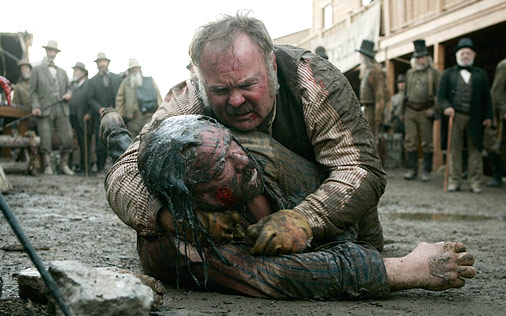
Ho. Ly. Crap. That was one of the most amazing fight scenes I have ever witnessed in a movie or TV show. Everything about it was mythic: The whole build-up over the last few episodes with Dan and the Captain taunting each other, shirtless Dan greasing himself up for the fight, Dan's "Come scare me in the thoroughfare" note, the brutal clumsiness of the fight itself, the fight going wrong just as Dan predicted, Dan coming back just as he predicted, Dan ripping out the Captain's freaking eye, and Al's barely perceptible nod to Dan to finish things, followed by Al walking back into his office without so much as a glance at Hearst's balcony.

Whew! Can I say that again? Whew! Or maybe, wow! Now, I love me some Jackie Chan/Jet Li lavishly choregraphed violence, but seeing something this ugly, this clumsy reminds me just how awful the real thing is -- especially when we cut back to Dan sitting naked in his room, his face buried in his hands, unable to deal with anyone or anything for a very long time. Outstanding work throughout (including the comedy in the scene where Bullock enters The Gem) by W. Earl Brown.

The dangling eyeball was the most shocking moment, but this was an episode full of stunners: Steve the hooplehead talking proud Hostetler into eating his own shotgun, a doped-up Alma throwing herself at a terrified Ellsworth (isn't it usually the guy in the sham marriage who wants to take things too far?), and Seth drawing down on Hearst and dragging the most powerful man in the camp towards a cell.

Since HBO sent out only the first five episodes, we have now reached the point where my knowledge of what's to come is the same as yours, and I couldn't be happier. I have no idea how Hearst will respond to this public humiliation, or how Al will try to counter it; whether Steve gets to keep the livery or the General insists on staying out of respect for Hostetler; how both Seth and Martha will react to the news that Alma's free and easy again; whether Alma can kick the dope again (if they stick to the consecutive day formula, probably not).

Hell of an episode. Unfortunately, I now feel the need to resolve all my conflicts by greasing up and beating someone to death with a thick tree branch. Hey, it's better than wanting to blow my head off with a shotgun whenever I deal with a customer service rep who won't do what I need.

Some other random thoughts:
  • More of the Doc this week than last, but his voice seemed hoarse and his bearing weak. I think he may be a lunger.
  • Milch never manages to work every regular into every episode, but it seemed there were more characters MIA than usual: No Joanie, no Jane, no Mose, no Martha, no Wu, and no Jewell. Am I forgetting anyone? Or did any of these people pop up and I just missed 'em?
  • I love Brian Cox as Langriche, and Dennis Christopher gets a lifetime pass from me for winning the Little 500, but feel like the theater company may be one subgroup too many on this show. On the other hand, I loved Richardson's more astute than it sounded, "Are they performing now?" as he watched the group move through what appears to be a long-standing series of off-stage routines.
  • Someone asked in the comments last week whether Con could actually be such an awful lover. I think we have our answer to that. The guy makes Commissioner Hugo "Motorboater" Jarry seem like the world's most attentive lovemaker.
  • Am I the only one getting a little tired of the Trixie/Sol dynamic where she berates him for not knowing about things she refuses to tell him? It's especially frustrating because he rarely has significant scenes with anyone else anymore.
  • Nice moment where, after mocking the General for the entirety of their conversation, Aunt Lou turns serious and wishes him and Hostetler luck.
  • Shouldn't the "what goes up must come down" rule of physics endangered Seth or someone else after he fired in the air to signal Steve and Hostetler?
  • Well, Hearst saw right through Al's plan to use Adams as a Judas goat, didn't he?
  • Some funny Farnum moments, including him trying to make himself look more important to Al's guys and him furiously scribbling "Bella Union" on a piece of paper to avoid another beating from Seth.
My note-taking wasn't as thorough this week, so no Milch-isms. Feel free to nominate your own.

What did everybody else think?
Click here to read the full post

Sunday, July 02, 2006

Deadwood: The good, the bad and the Steve

"Deadwood" episode four spoilers after the jump...

I know Dan said that "Fixin' toward a bloody outcome" line back in the season premiere, but rarely has it felt as prophetic as it did in episode four. Everywhere you turned, there were people ready to rip each other's heads off. Al and Hearst. Dan and the Captain. And, of course, Hostetler and Steve the drunken horse molester (aka Steve Fields).

Richard Gant and especially Michael Harney spent most of the episode bottling so much rage that it looked on several occasions like Milch was going to pull a "Scanners" and feature some exploding heads. And that's on top of Tim Olyphant, who always plays Bullock as one bad tech support voicemail session away from turning spree killer, and who got to amp that up even more as Seth tried and failed to stay calm while negotiating peace between the man whose horse killed his son and the most hateful man in the camp. (And in a place that includes Cy Tolliver, George Hearst and E.B. Farnum, that's saying something.) The fact that Steve's presence is tolerated anywhere in camp, even at a dive like the No. 10, and that someone like Harry Manning seems to consider him a friend suggests that we may actually be spending most of our time visiting the camp's classier individuals.

(Then again, there's always Con Stapleton -- not to mention his "identical twin.")

It's odd how Bullock went from being the show's main character to a tight-assed joke most of the time, but this felt like the most Bullock-heavy episode we've had since the show's early days. I do think he's a more limited character than Swearengen (and, much as I like Olyphant, he ain't in Ian McShane's league), but I like seeing Seth struggle to fit in and do the right thing all the time, even though he's about as much a wild animal as Dan Dority.

Speaking of Al, we get the return of his preferred method of thinking: while getting serviced by one of the Gem girls. McShane just about broke my heart with the look he gave the whore when she said she wanted to vote for Harry because "Bullock yells at you." I could do without the soliloquies about his abusive childhood, however; McShane's so good that we understand Al's emotional scars without him having to explain them to us.

Now what do you suppose Hearst's playing at? Clearly, Cy is his man on the street, and after that bit with the pickaxe he knows he can never trust Al, so why bother pretending to split the pie? Why not just arm up Cy with some of his muscle and wipe out Al and his bunch. Al and Dan are tough, but Hearst could hire an army to wipe 'em all out under cover of darkness if he wanted.

And in the other key development of the evening, the bank opens and Alma gets right back on the dope. At first, when Leon was lurking so oddly at the bank, I couldn't figure out what his play was. Then I remembered that he's in charge of Cy's drug operations, and when he nodded to Alma from the street that night, I knew. Poor, oblivious Ellsworth's now gonna have him a junkie fake wife.

Some other random thoughts:
  • Franklin Ajaye's delivery of "Nigger, nigger, nigger" when Hostetler wouldn't sign was a thing of beauty. Glad to have the General back in town, though it's odd that he would bother sending Jane the telegram if he and Hostetler were just gonna ride in without waiting for a reply.
  • When Ellsworth said, "As far as the conjugal enterprise, I'll admit feeling like a schoolboy," I was taken aback, since I had assumed he and Alma didn't even kiss, much less make the beast with two backs. Then I looked up "conjugal" and was reminded that all it means is "of or relating to marriage or to the relationship between a wife and husband." Too many prison movies have corrupted the definition for me, I guess.
  • Last week gave us Al's complaint about how long it takes Merrick to ask a question, and this time we get Seth doing the same with Charlie ("Is that your goddamn idea of quick, Charlie?") and Al with Hearst ("Can you say it straight out before I have a fuckin' birthday?"). But even though Milch is aware of how contorted his dialogue has become, don't expect it to change. (At least, I hope not.) Late in his run on "NYPD Blue," when all the characters were beginning to talk like 19th century dandies, there were several occasions where a guest character would make similar meta-complaints, but the lingo didn't get any clearer until after Milch left.
  • Cute little moment where Joanie and Jane contemplate the future of the Chez Amie and can't figure out where Jack is going to put his stage. Felt a little like a wink at the audience (Joanie's never been funny in quite that way), but I'm okay with it.
Milch-isms of the week:
  • Dan responding to Hearst's greeting: "Morning. Best time of day to go fuck yourself!"
  • Joanie responding to Jack's offer about renting (and continuing the theme): "Perhaps you'd consider fucking yourself."
  • Al on Hearst's invitation: "Fuckin' Hearst, must take me for an optimist."
  • The General being sarcastic: "That's why I came back with you, Hostetler. To worsen my chances when it's time to flee!"
  • Jane on Steve: "Tars every fuckin' drunk with his brush."
  • EB to himself: "When will I raise courage to search that woman's room?"
What did everybody else think?
Click here to read the full post

Sunday, June 25, 2006

Deadwood: You can leave your capon

Spoilers for "Deadwood" episode three after the jump...

Okay, I am officially scared of Gerald McRaney. Here's a guy I always thought of as a meat-and-potatoes actor, someone who got the job done and not much more. When Milch cast him as Hearst, I assumed there was more to the man than I had seen, but I never imagined him being this bloody good. When Hearst leaned in and told Alma, "You are reckless, madame. You indulge yourself," I don't think I've been as frightened by a fictional character as I was with Gene Hackman's "I'm gonna hurt you. And not gentle like before... but bad" scene from "Unforgiven." If this was a feature, I have no doubt Hackman would be playing Hearst, and I doubt he could play him much better. Sometimes, an actor just needs the right material to show his stuff.

(Hands up, anyone who already knew what a capon is. I had no clue, but upon looking it up, that's exactly how Hearst would view his role in Alma's proposed deal.)

Though he shows no interest in the town beyond its gold, Hearst is a good fit for Deadwood. The town is filled with people incapable of functioning in more polite society, and as Hearst admits to Aunt Lou (who, not surprisingly, is only faking the whole mammy act), he shouldn't be around regular people. The problem is, where Swearengen or Bullock recognizes his need for others, Hearst views himself as the God of The Color, answerable to no one. (Who says evil corporate barons first sprang up in the 1980s?)

As I said last week, the bonds of history are going to prevent any kind of definitive victory for Al in this fight, and as the episode begins, it looks like Al is already waving the red flag, despite Trixie's protest that "the last shot ain't been fired." It isn't until the arrival of Jack Langrishe, of all people. I don't know whether the real Langrishe had met Al years before he arrived in the camp, but my mind is swirling with visions of how these two men became friends.

In a way, it felt like this was the season premiere, what with the arrival of new characters like Jack and Aunt Lou, the return of others like Wu and Blazinov, plus Al's tour of the camp. (When he told Jack, "This is new," it was like Milch was showing off the additional sets they had built during the hiatus.) Brian Cox is one of those actors I'll watch in anything, and he finds the right balance between flamboyant and tough.

On the other end of the capon scene was Alma, who finally appears to be recognizing the limits of her sham marriage, especially now that she no longer needs Ellsworth to pose as her baby daddy. And unfortunately for Ellsworth, he sometimes forgets his place and tries to assert himself like a real husband. Not that Alma would have listened to anybody once she gets her mind set on something, but her "You hardly need explain yourself to me, your wife, in the thoroughfare, having laid down the law…" line was some cold sarcasm. Also interesting that, when Ellsworth later says he was trying to protect her, she barks, "You. Can't." So who can? Bullock? He got his lunch stolen by Hearst, who finally revealed the purpose of letting Al kill two of his guys while two other witnessed: now he has a Mutually Assured Destruction option should Al's ally Bullock ever come up with real evidence of his wrongdoing.

Some other random thoughts:
  • While each episode usually takes place the day after the previous one ended, there are occasional exceptions, like the 10-day gap between last week and this one, which was necessary if for no other reason than to avoid having Alma bedridden for most of the season. Oddly, there's a reference in one of the next two episodes to six weeks having passed since William got trampled by the horse, and since a week elapsed between that episode and the season two finale, does that mean only four weeks elapsed between seasons? Or maybe I should just repeat the line one of the "Deadwood" writers once gave me after attempting to explain the season one chronology: "Now my brain hurts."
  • At what point did Farnum turn into Renfield from the Dracula movies? His lurching and shuffling almost distracted me from the comedy of Hearst talking over E.B.'s "haughty cunt" line. Almost.
  • Not sure which was funnier: Mr. Wu's new look or Blasinov demonstrating his new telegraph equipment to Merrick. Funniest of all was Al's pantomime routine: "'Hello, hello, hello.' The many Chinks."
  • What the hell is wrong with Doc Cochran? It's never good when you cough up blood.
Milch-isms of the week:
  • Al giving some meta-critique: "Ever wonder if you expressed yourself more directly, Merrick, you might fucking weigh less?" (Followed by Merrick's meta-rebuttal: "I see no logic in that whatsoever.")
  • Al exaggerating his resume to Wu: "Swidgen must act as translator, as he is the only one in camp versed in both languages."
  • Al irritated by Jack sucking up to Merrick: "Shit blizzard's early today."
  • Farnum the unsubtle bigot to Hearst: "What depraved creature of exotic origin have you engaged to take my place?"
  • Al on the local bacon: "Might have a human aftertaste."
  • Al on Bullock: "Insane fucking person."
  • Cy kissing Hearst's ass: "If you hadn't met me to wag it, sir, why would the Lord give me a tail?"
Matt's take is posted here. What did everybody else think?
Click here to read the full post

Sunday, June 18, 2006

Deadwood: Bring the pain

Spoilers for "Deadwood" episode two after the jump...

Is it wrong that I want to see Al Swearengen get a finger chopped off with a pick-axe every week? Am I a sadist if I love watching reruns of the kidney stone arc from last season? Or am I a masochist for the way I love watching Ian McShane portray the repeated passions of the Swearengen? Honestly, I'm not sure I've ever seen an actor do a better job of conveying physical pain than McShane does in moments like tonight's closing scene; whenever Al suffers, I wince.

While Al may insist "I'm having mine served cold" (who knew Klingon proverbs were so popular in the Old West?), I'm damned curious to see how the show deals with this conflict. While Milch has introduced some fictional characters like Alma and fiddled with the personal details of real ones like Bullock (Martha was never married to his brother, and they had a daughter who never got horse-trampled), he's not going to make a radical break with history by having Al or Dan execute George Hearst. Since I've seen the next three episodes, I won't speculate too much, but Hearst is the first opponent who's dramatically won the upper hand over Al. Al was so confident that Hearst and the Captain wouldn't try anything -- or that, if they did, he could stab his way out -- that he went over there solo, and didn't even attempt to signal to Dan and the guys when they forced him inside at gunpoint. And if Al is going to win even some small measure of revenge over Hearst, he's going to have to follow his own advice to Dan -- "Change calls the tune we dance to." -- and stop thinking like he can out-think and out-tough anyone.

Maybe he can learn a lesson or two from Calamity Jane, who for one afternoon was able to dry out, clean up her body (that's a nude scene I never expected) and her language, and be an effective, entertaining guest lecturer for the schoolkids. Just a fun, sweet sequence all around, especially the revsiting of her bond with Sofia and her brief compliment to Martha. ("I know another brave person her, too... several.") History (both real and the show's) says this isn't going to last, but it was a nice moment.

Like many fans, I've never really warmed to Alma, and Seth's ring of fire love for her is my least favorite element of his character (he really is the Ryan Atwood of the Black Hills), so I wasn't too caught up in the drama over whether Alma or the baby might survive -- until, that is, she went and passed over Ellsworth in favor of Seth as Sofia's legal and financial guardian. Jim Beaver was so good in that moment. Ellsworth has no illusions about this "marriage," but he's been there for Alma and Sofia when Seth has chosen (with defensible reasons) not to be. For Alma to say, essentially, that his only value was as a beard and that she'd rather turn Sofia's care over to another man was a major slap in the face to one of the most stand-up men in the camp.

Some other random thoughts:
  • Does Charlie understand that Joanie's a lesbian? Does he have a libido? I know he's a good guy -- like Sol and Ellsworth, one of the least complicated, most altruistic man in the camp -- but does he really expect nothing out of this but friendship? Whatever his motives, the scene where he recalled Wild Bill's own self-loathing was very touching.
  • On the flip side of the humanity spectrum is Cy, whose initial response to Joanie's suicide talk was, "What the hell were you doing at Shaughnessy's?," then complains to himself about having to listen to such a story. Then he goes and uses his alleged spiritual awakening as a ruse to pull a gun on Andy -- a scene that Leon thankfully ruined.
  • The monologue the drunk delivers before falling and breaking his neck (which inspired the episode's title, "I Am Not the Fine Man You Take Me For") sure sounded like the kind of thing Milch read in a letter and transcribed.
  • Watching the Doc use Trixie as his vagina model to test the angle of the mirror reminded me how handy her lack of self-consciousness can be sometimes. Almost makes me willing to give her a pass for all the times she yells at poor Sol. (Also liked the oblivious Sol doing his "I bought the house!" pantomime while Trixie is tending to Alma.)
  • During Deadweek, Andrew Dignan wrote an essay comparing "Deadwood" to the "Godfather" films, and watching Adams and Dan constantly jockey for favor with Al reinforced the parallel for me. Al is Don Vito, the stately power broker. Dan is Sonny, the hotheaded eldest son who's good at muscle work but doesn't have the brains to succeed the old man. Adams is Michael, whose savvy and sophistication is sometimes held against him by the other brothers. And Johnny is, of course, Fredo. Not sure it's intentional, but if fits.

And some Milch-isms of the Week:

  • Mose hearing that Jane is taking a bath: "Camp get up a petition?"
  • The Farnum 'n Richardson Smiletime Hour: "I'd like to use your ointment to suffocate you."
  • Charlie walking into The Gem seconds after the two killings: "I'll drink after I vet."
  • Dan explaining things to Johnny: "It was his preliminary signaling that he was gonna show Al his ass."
  • A fart fills the air at The Gem: "That'd knock the buzzard off a shitwagon."
  • Farnum the unsubtle race-baiter: "Farnum, twice-measured; Starr, once cut" and "Farnum! CHRIST knows he's earned it!"

Matt's review is already up on NJ.com. So what did everybody else think?

Click here to read the full post

Sunday, June 11, 2006

Welcome back to f-in' Deadwood!

"Fixin' toward a bloody outcome, boss." -Dan Dority

And with that prophetic opening line, we're back in the blood and shit-stained thoroughfare of "Deadwood," for a season premiere filled with negotiations, circumlocution and more than one bloody outcome. More after the jump, for the benefit of anyone who hasn't watched it yet. (And if you haven't, Deadweek is a great way to put yourself in the mood.)

Thank God for the Johnny Burnses of this show, because there were large chunks of the premiere where I badly needed someone to explain the plot to me. And what purpose does The Gem's barkeep serve if not to allow Dan or Al deliver several foul mouthfuls of exposition?

So let me make sure I have this straight: the Cornish workers at Hearst's mining operation have been agitating for better pay and conditions, so Hearst sends a couple of his goons to kill one of the Cornish at The Gem, sending two messages in the process: 1)Organize against me and die, and 2)I can do whatever I want, wherever I want in this camp -- up to and including the place of business of Deadwood's unofficial mayor. And Swearengen, knowing that Hearst needs the elections to go forward as much as he does (elections legitimize the government, which in turn speeds up the process of annexation and helps assure a level of independence from Yankton), plays the one card he has at the moment by postponing the campaign speeches. That sound about right?

As Al put it to Dan, "Don't I yearn for the days a draw across the throat made fuckin' resolution?" Amen, brother.

In all seriousness, while Milch sometimes makes the plot and dialogue so labyrinthine that I feel the need to hire a Talmudic scholar to keep track of it all, I wouldn't want Al to still be the self-interested cutthroat from early in season one. Change is the dominant theme of "Deadwood" -- the change from lawlessness to order being the biggest, but personal change for everyone -- and no one has changed more than Albert (did we know that was the full name?) Swearengen. Anyone who watched the pilot episode -- in which Al looked like the black hat destined to go up against Wild Bill and/or Bullock -- and then jumped ahead to this one would probably be stunned at his transformation into this paragon of community. He helps stage elections! He buys Sol Starr a house! He sets things up so Trixie can essentially move in with Sol with no one in town being any the wiser!

Which isn't to say that Al has become Fonzie circa the episode where he got his library card. He's still a hard man, capable of staring down one of the richest men in America, downing a bottle of the man's whiskey in one sitting and making a power play that could bring down more trouble than he, Dan, Johnny and Adams can handle.

It's hard for me to judge this episode in isolation, because I've seen the season's first five. In that group, this was one of the weaker hours, but it's just so great to have this show back, to hear Ian McShane wrap his tongue around Milch's dialogue, to witness the show's various two-person comedy teams (Joanie and Charlie, Jane and Mose, Farnum and Richardson) go through their assigned roles, to watch Tim Olyphant play the mental switch-flip between Stick Up His Ass Bullock and Homicidal Rage Bullock... so many pleasures. How the blazes could HBO have canceled this show?

Before I start approaching Norman Mailer length, some other random thoughts:
  • Cy Tolliver lives. Powers Boothe's presence at a press conference on the set last summer (an eventful day that included Paula Malcomson explaining how the actresses use "snatch packs" to keep cool in their unforgiving wardrobes, not to mention me getting a double blow-out on my rental car) spoiled the surprise, if you can even call it a surprise. Milch has too much affection for Boothe (who was the second choice to play Swearengen, in between Ed O'Neill and McShane), and with Al morphing into a vaguely more benevolent figure, we need Cy to illustrate the darker side of humanity.
  • He'll get even more of a showcase in the coming weeks (episodes three and five in particular), but I'm amazed by how good Gerald McRaney is as Hearst. He's a guy I always thought of as a reliable meat-and-potatoes actor, no more and no less. Here he's playing the Gene Hackman part and playing it well. Sometimes, all an actor needs is the right material to show his chops, and shockingly, neither "Simon & Simon" nor "Major Dad" qualified.
  • Getting back to the idea that the pilot was setting up a Swearengen Vs. Bullock paradigm, it's almost comical to see the two act as allies, albeit allies whose interests only occasionally intersect -- and to see Bullock downgraded from our hero to this hothead who routinely loses his shit and pummels someone over Alma.
  • I haven't rewatched the season 2 finale in a while, but was there talk of Alma and Ellsworth having a house built or buying a pre-existing house? Because that's an awfully nice place to be ready only six weeks after the end of last season, show-time.
  • Milch has talked for years about wanting to depict the possibly apocryphal story where Wyatt Earp shows up in town and Bullock sends him on his merry way. I understand that, very early in the writing process for the premiere, the "Parp" gunman was going to be revealed to be Earp himself. I still wouldn't be shocked to see the famous lawman pop up before the season's out.
  • I know HBO claims they don't do product placement, but can't you imagine the endorsement opportunities for Ian McShane and some kind of cleaning product? "If it's good enough to scrub blood off the floor of Al's bar, it's good enough to get orange juice off your couch, by God!"
  • "It's my family luck, over centuries," Steve tells Harry Manning, "to get repeatedly fucked up the ass." So is that why you fucked the horse in turn, Steve?
  • Having lost his ownership of the hotel and seemingly on the verge of losing the mayor's job to Sol, Farnum really doesn't serve a purpose to the community or the show anymore, except as a fool. His scenes with Richardson are the most blatantly Shakespearean this show does (at least until Brian Cox rolls into town in a few weeks), and I alternate between cringing and loving them.
  • Who do you think is filled with more self-loathing: Jane or Joanie?
  • In case you missed Wu, he won't be back until episode three, but his entrance is a beaut.
Back when I was reviewing Milch's "NYPD Blue" episodes, I had a Line of the Week feature that inevitably turned into many lines of the week. Here's just a sampler of Milch-y goodness from tonight:
  • "As to your meeting with Hearst, if the chances comes up natural, stomp on the cocksucker's foot."
  • "Wash and stack, shit-monkey. Or ready yourself for worse!"
  • "My snatch is clean!"
  • "Another day on the right side of the ledger far as pus."
  • "Hell of a beating for EB to take if he's innocent,"followed by "Oh, he's still way ahead of the game."
  • "Custer was a cunt. The end."
If that's not enough for you, Matt offers the first of his own "Deadwood" recaps over at NJ.com. So what did everybody else think?
Click here to read the full post