Showing posts with label Extras. Show all posts

Sunday, December 16, 2007

Extras: Keep your girdle on

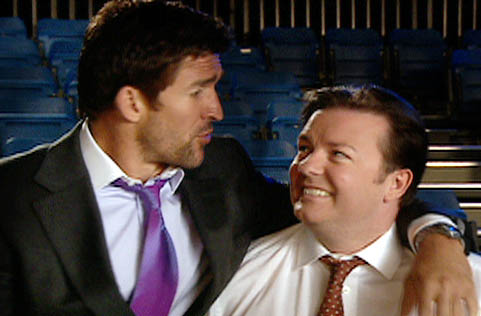
Brief spoilers for the "Extras" finale coming up just as soon as I give a male friend a hug near an open window...

My love of "Extras" -- well, at least, of the second season and now of this movie -- hasn't been shared by the world at large, or even by the much smaller world of Ricky Gervais fans. Previous columns and blog posts on the subject haven't generated much feedback, and most of the original recipe "Office" fans I know seem either unaware of or uninterested in Gervais and Stephen Merchant's follow-up.

That's a shame, because while "Extras" will never have the bracing, fresh quality of "The Office," it's an even deeper, nastier examination of the cult of celebrity that's pacifying Western Civilization. And of the two works, it's the one I find myself going back and revisiting more. (I will never say a bad word about the character of David Brent, but it often pains me to revisit him in a way that Andy Millman doesn't.)

I mostly said my piece on the movie-length finale in my column on Thursday -- much of it is a thematic rehash of the season two finale, but parts of it had me laughing so hard I gasped for air, and Ashley Jensen is superb, both in the more serious moments and the funny stuff -- so for the three of you who care about this special, I'm just gonna rattle off a list of the moments that had me especially pained with laughter or wondering why the living room was so dusty:

-The department store sequence, complete with racist Michael Richards doll;

-Maggie assuming Andy would be Jewish in a world without Christmas;

-Maggie watching the heavyset "While the Whistle Blows" actor pick over the last of the craft services food, only to be saved from deciding whether to eat it when Andy calls her to his dressing room;

-Andy's girdle exploding in mid-audition (and "exploding" is a pretty good description for my laughter level at that moment);

-Darren and Barry coming up with a system to deal with his busted zipper;

-The mortified look on Maggie's face throughout the Clive Owen/whore scene, followed by Clive's reaction to Maggie's elderly replacement;

-Andy acting above the whole "England's number one catchphrase" thing, followed by that all-catchphrase episode of "When the Whistle Blows";

-Maggie being shown her spider-infested new apartment (one of those scenes that was hilarious and tragic at the same time);

-The neighborhood kids calling Darren and Barry gay (a cheap joke that was expensively set-up, if you know what I mean);

-Darren trying to jump over the plexiglass barrier, followed by Darren's usual goofy smile seeming like the saddest thing in the world when he realizes Andy won't give him a pass;

-"Fame is a mask that eats... into the face!"

-Darren, Barry and the other Carphone Warehouse guy doing their ridiculous dance every single time that one ringtone goes off;

-Andy as a farting slug alien on "Doctor Who";

-The "celebrity" "Big Brother" contestants insisting they haven't given up their dignity, followed immediately by them doing the Chicken Dance on cue;

-The entirety of Andy's anti-fame rant (maybe more on the nose than Gervais and Merchant's usual stuff, but they've said this is the last work they're going to do on celebrity, and they clearly had a lot to get off their chests);

-The lad mag girl being moved by Andy's speech, but still insisting on putting on a bikini before walking out;

-Andy and Maggie riding off to the sunset as "Tea for the Tillerman" plays one last time. (Can't wait to hear the exit music for their next series.)

What did everybody (or all three of you) think?
Click here to read the full post

Thursday, December 13, 2007

All TV: An 'Extra Special' treat for a bleak season

Today's column reviews the Christmas finale to "Extras":
A year ago at this time, I listened to Ricky Gervais tell me that he had no interest in continuing "Extras," his comic follow-up to the original British version of "The Office."

"What's the point?" he explained. "Got other things to do, really."

Demonstrating a rare sense of TV perspective, he followed that up by admitting, "But then again, that's like saying, 'Do you want to be on telly?' 'What's the point?' I've just reduced my life's work to 'What's the point?' My gravestone: 'He did "The Office." What's the point?' "

Still, he seemed like a man who had a story to tell -- in this case, about a film extra and wannabe actor named Andy Millman (Gervais) who becomes famous but miserable as the creator and star of an awful but popular Britcom; had spent two seasons telling it, and was done.

So what, then, is the point of "Extras: The Extra Special Series Finale," which HBO is airing Sunday night at 9?
To read the full thing (which gets more positive as it goes along), click here. Click here to read the full post

Monday, February 19, 2007

Pathetic little fat men

Spoilers for "Extras" and "The Amazing Race" coming right up...

And so "Extras" comes to an end, but not before we had to witness Darren Lamb and Barry off "Eastenders" each making friends with himself -- plus the implication that Robert DeNiro would be doing the same thing shortly. To quote Rainier Wolfcastle, my eyes! The goggles do nothing!

I liked that the finale had the same quasi-hopeful tone of "The Office" Christmas special. Andy's going to meet Robert DeNiro, but you don't know if any work will come of it. Andy has recognized how badly he was treating Maggie, and they're maybe flirting a little, but chances of a relationship blossoming are probably slim. Darren manages to wrangle the DeNiro meeting, but he's still an imbecile. And, of course, the final bit about the nurse preferring edgy BBC2 comedies, followed by Robert Lindsay's, "What are you, a critic?," was a nice kiss-off.

I've never been an "Amazing Race" die-hard for a lot of reasons -- scheduling, the fact that it makes me feel overcaffeinated and gives me flashbacks to all my worst travel experiences -- but I've watched it off and on over the years and am going to give the All-Star season a try. Despite Phil's hyperbole, it doesn't seem like these are, in fact, the best 11 teams ever. (Certainly, if I was only going to include one set of winners, it wouldn't have been Uchenna and Joyce.) I remain both amused by everyone's hatred of Rob and Ambuh and impressed by his skills. If you're going to make "reality game show contestant" your career, you better be good at it, and Boston Rob is. But my opinion about them is the same as it was in season seven: I want them to stick around a really long time for entertainment value, but not win.

The team I was rooting for going into last night were Kevin and Drew, and not just because Kevin's a Jersey guy. They're funny, they're good guys, and, in the first go around, they were really good racers. This time, I just feel sorry for them. Drew obviously has some pre-existing injury stuff going on, and the two of them both seem like they don't want to be there. Unless someone hits Drew with the purple healing ray in a jiffy, I can see them maybe outlasting the cannon fodder like David and Mary (who suddenly decided to lie at the most useless, backfire-ensured possible time), but not much past that. Sigh...

This didn't seem like that exciting a leg, though squeezing 11 teams into a one-hour premiere didn't help. The Detour choice was too easy once you realized the cowboys were going to do all the hard work, so outside of getting to the Miami airport early and not getting lost in Ecuador, there wasn't a lot people could do to change their fates.

What did everybody else think?
Click here to read the full post

Sunday, February 11, 2007

Extras: Whisk-y business

Spoilers for "Extras" just as soon as I see what happens if I jiggle the handle...

I learned a long time ago not to try to make comedians or comedy writers laugh, because the odds of me actually succeeding are far outweighed by the likelihood of me annoying them. So it was with some measure of shock and delight that I induced a prolonged, red-raced giggle fit from Ricky Gervais -- though, of course, I was quoting his own show back to him. While we were discussing Stephen Merchant's acting contribution to "Extras," I mentioned the scene from this episode with Darren, the toilet and the whisk, and Gervais just lost it. I had never seen anything like it among a comic of his stature -- even their own material doesn't generally affect them that deeply, that long after the creative process began -- and I think it's a measure of Gervais' affection for his partner, not to mention the power of a good joke about poo.

Darren's triple-flusher (another fine example of his complete single-mindedness, ala his attempt to unload the flatscreen) was the best, but far from the only example of juvenile humor running through this episode. Andy retreated into being a teenage boy at the sight of the BMOC from his schooldays (played by Jonathan Cake, TV's go-to Handsome Bastard of the moment), becoming even clumsier than usual, in every respect. I don't know exactly what you call that bit with him and the exploding seltzer bottle -- an anti-spit take? -- but I was a little awestruck by it. And, of course, there was the whole 12-year-old "Ewww! Boys kissing!" attitude towards Sir Ian's play, with Andy's fear of being mocked by the cool guys from school causing him to completely bollix up his opening night.

McKellen's cameo felt a little too much in the vein of Patrick Stewart's last season, but I still chuckled at how he expected Andy to view his words as a stunning revelation akin to Morpheus explaining The Matrix to Neo.

One more episode to go. What did everybody else think?
Click here to read the full post

Monday, February 05, 2007

Extras: Being Ronnie Corbett

Some thoughts on "Extras" just as soon as I do a quality-control test on the new Sepinwall talking action figure...

"Extras" is technically a co-production between the BBC and HBO, but Gervais and Merchant have never much bothered with concessions for their American audience. The first episode of the series (which HBO aired fourth, for understandable reasons) was built around a rivalry between Ross Kemp (who?) and Vinnie Jones (slightly less of a who?, though you have to be either a soccer or Guy Ritchie fan to care). Another episode had Les Dennis (again, who?) as its main guest star, and a big gag in the season two premiere dealt with Keith Chegwin (huh?) being brought in for a small role after Paul Shane (really, at this point I'm lost) turned it down. And the final episode of this season is going to hang heavily on Jonathan Ross (vague idea).

Obviously, the show's also used plenty of very famous guests, but the fact that Gervais and Merchant never bother to explain who the For Brit Eyes Only guests are, or what some of Andy's older cultural references are about, occasionally gets in the way for me. I get that Chegwin's a newscaster of some kind who has no idea how to act, but I had no idea who Ronnie Corbett was or what he looked like, so when Andy mentioned last week that he lost his virginity to a girl who looked like Corbett, it didn't resonate (for all I knew, Ronnie was short for Veronica), and when he stumbled into that men's room stall with Darren doing coke with none other than Mr. Corbett, it wasn't nearly as funny as it no doubt would have been for fans on the other side of the pond. (Plus, as Gervais explained to me when I expressed some confusion, Ronnie Corbett is apparently the last famous man in England you would expect to find doing lines in a men's room stall. Again, over my head.)

Still, this was another painfully funny example of Andy winning fame without respect, suffering one humiliation after another, from his "Pretty Woman" revenge fantasy going wrong due to his own cheapness to the action figure gag to being banned from even the Welsh BAFTAs. Plus, Chris Martin whored himself out nicely in his cameo, and I loved the look on Andy's face as he watched Martin pointlessly sing "Fix You" on the "When the Whistle Blows" stage. On the one hand, he's disgusted that he's again allowed his vision to be so terribly compromised; on the other hand, he's obviously pleased to have such a great view of the performance.

What did everybody else think?
Click here to read the full post
Sunday, January 28, 2007

Extras: The trouble with Harry (and his Johnny)

Spoilers for "Extras" just as soon as I can convince Marian that our flatscreen isn't too big for the room...

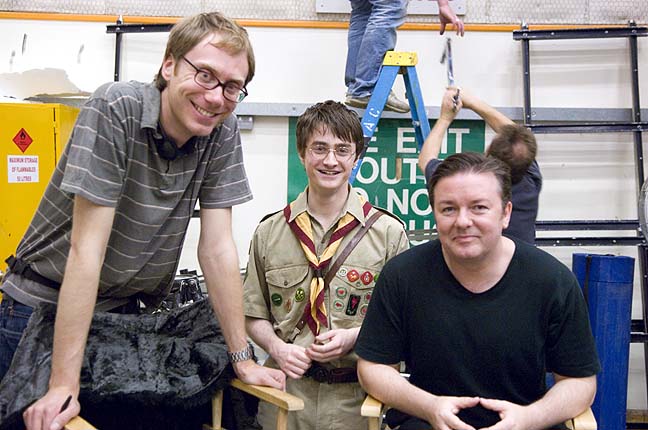
And here's where season two launches itself into the laugh stratosphere I was expecting when I heard Gervais and Merchant were doing a new show. Everything worked, from little stuff like Darren trying to unload his TV to more obvious comedy like Horny Harry Potter. (While the celebs don't generally have anything to do with how they're written, Daniel Radcliffe came up with saying "Ring don't mean a thing.") I've seen the scene with Radcliffe, Andy, the unwrapped Johnny and Diana Rigg a half dozen times, and it still makes me double over in laughter.

This was also one of the better fake movies they've done, as I can totally imagine Radcliffe getting typecast in bad fantasy movies for a long time after the Potter series ends. And I like that Dame Diana escapes with her image totally unscathed. For a moment, I thought that when he asked about the "Avengers" catsuit, she was going to invite him to her dressing room, but having her maintain her dignity was much funnier.

But the real genius of the episode was the Down syndrome subplot, which Gervais said they came up with in season one but wanted to save until Andy was famous. I skim the covers of Us Weekly and In Touch at the supermarket, have Defamer and Deadspin bookmarked and have helped Marian recuperate from back surgery by regaling her with very-detailed tales of the Cameron Diaz/Justin Timberlake/Jessica Biel Golden Globes kerfuffle, and the way Andy was treated by the press was only slightly exaggerated, if that, from the way he would be in real life. Loved the reporter literally digging through the trash and then acting like he was just stopping by, telephone game exagerration of the incident, and especially Darren baiting the talk show host into playing Guess The Mongoloid.

What's interesting is that Andy should know better about everything, should know by now not to say anything potentially damaging to Maggie the blabbermouth, should know that Darren will never, ever make any situation better. So while he's not as actively creating his own misery as David Brent, he's not an innocent victim, either.

What did everybody else think?
Click here to read the full post

Sunday, January 21, 2007

Extras: Pathetic little fat man, no one's bloody laughing

Spoilers for "Extras" (posted early because I may be computerless for a while) coming up just as soon as I find a vagrant to help me make change...

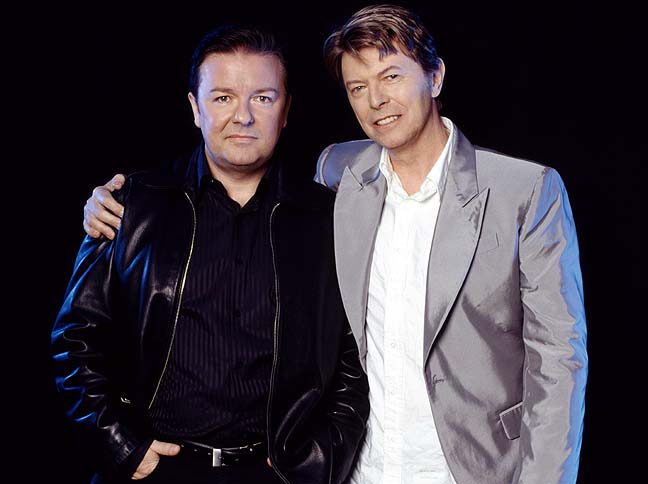
Of the early episodes of season two, Ricky Gervais said, "We go through the journey of seeing the difference between fame and infamy. Fame without respect is nothing." Boy, howdy. Having sold out completely to the BBC to get "When the Whistle Blows" on the air, Andy is quickly learning that difference, illustrated handily when he meets David Bowie, a man of genuine fame and talent who quickly sizes up Andy for the desperate hack he's become, then uses the talent that made him famous to instantly pen a devastating musical take-down. (In real life, Bowie wrote the music, and it sounds like Gervais and Merchant did the lyrics.)

My favorite part of that scene was Maggie helping Bowie write the song, yet another example of her congenital inability to lie, no matter how much she needs to. (Ditto her crumbling on the autograph scam in the face of Andy's suspicious new neighbor.) I think Darren's the most consistently funny character on the show (loved him explaining the pointlessness of critics), but I just enjoy watching Ashley Jensen work. (And since "Ugly Betty" has unintentionally fallen off my radar, this is the only place I'm seeing her right now.)

The scenes with Andy and the bum were the most "Curb" this show has felt in a while -- probably too much. Andy isn't Larry David, and I couldn't help but feel like asking the bum to make change is the sort of thing Larry would pull (and then act outraged if the bum refused to do it). Much better was his encounter with the scary-obsessive fan who kept repeating "the wig, the catchphrase, the glasses" over and over like it was his mantra. It's both sad and hilarious that Andy had to go see the guy again to pick himself up after the Bowie fiasco.

The Bowie song aside, this was probably my least favorite episode of the six, but it's also a necessary one to establish what's to follow, in terms of Andy's newfound celebrity and the complete worthlessness of same.

What did everybody else think?
Click here to read the full post
Sunday, January 14, 2007

Extras: What a damned handsome man

Since the Ricky Gervais interview post is so damn long, I'll handle the details of the "Extras" season two premiere here. Spoilers coming up just as soon as I Google Keith Chegwin...

As I've said in the past, I didn't love season one. I felt like Andy was a bad fit as central character for Gervais and Merchant's style of uncomfortable comedy, since more often than not he was the victim of circumstance, where David Brent always brought the humiliation on himself. There were too many incidents where I just felt sorry for him.

But with Andy so brazenly selling out his creative vision with "When the Whistle Blows," it's become much easier for me to laugh at him, as well as with him. (As opposed to Barry from "Eastenders," since according to Darren, "The thing about Barry is, people will laugh at him, they never laugh with him.") I still felt some sympathy for him at the end, at his realization of how much people enjoyed the stupid wig and glasses and catchphrase, and at that look between him and Maggie, but it's the same way I can feel bad for Michael Scott for growing up friendless and still find it painfully funny when he can't bring himself to fire Creed.

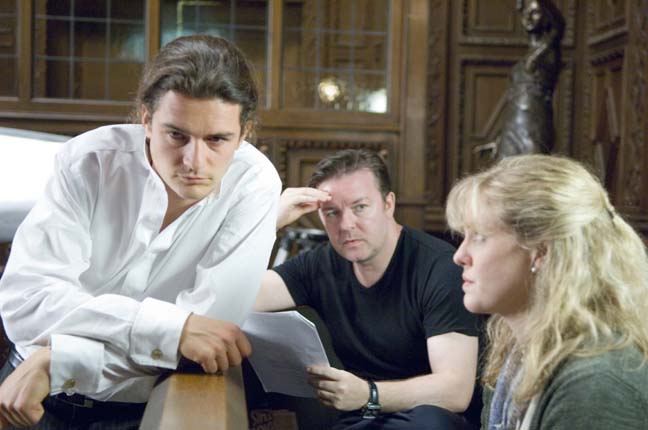
Orlando Bloom's guest spot was one of the funnier ones (though not up to Kate Winslet or Patrick Stewart), particularly the scene where he was so desperate to get Maggie to look at all the magazine stories discussing his magnificent beauty. However, Bloom couldn't hold a candle to Keith Chegwin. I have no idea who he is, save what was said about him, but the whole sequence where Keith couldn't get anything right was a scream. ("Door's stuck." "That's lunch.") And, of course, the racist/homophobic exchange afterwards (particularly David's inability to think of a single funny English black man) was the sort of thing they probably couldn't get the more famous guests to do.

What did everybody else think?
Click here to read the full post
Talkin' comedy with Ricky Gervais

As briefly discussed last month, I interviewed Ricky Gervais in advance of the new (and vastly improved) season of "Extras." The story's in today's paper:
So, Ricky Gervais, do you want to make a third season of "Extras"?

"What's the point?" he shrugs. "Got other things to do, really."

Then he pauses, realizing what just came out of his mouth.

"But then again, that's like saying, 'Do you want to be on telly?' 'What's the point?' I've just reduced my life's work to 'What's the point?' My gravestone: 'He did "The Office." What's the point?' That's the terrible thing. When you're not a pioneering heart surgeon or a leader of men, what's the point?"

Legacy has been very much on Gervais' mind as he comes to the end of what he and writing partner Stephen Merchant jokingly call "our Picasso blue period," or, more plainly, "our fame period."
To read the full story, click here. Or, if you're just drowning in free time, a full interview transcript is below.


(If you're reading this transcript without having read the Ledger story, here's what you have to know about season 2: Andy's "Office"-like sitcom gets noted to death by the BBC until it's "When the Whistle Blows," this broad, hacky, "Are You Being Served?"-style sitcom where Andy has a floppy wig and oversized glasses and a catchphrase he's required to recite every 10 seconds. There will be some spoilers, mainly of jokes. In certain cases, I tried to obscure them in the transcript; in others, it was impossible to. So you may want to save this until after you've seen all six episodes.)

Watching the new season, I couldn't help thinking that "When the Whistle Blows" is what I feared the American "Office" was going to be.

I suppose, like most of the stuff I do, it's a bit of "There but for the grace of God go I." Like, that could have happened. What would I have done if, when I walked into the BBC and said, "Listen, I've got this thing called 'The Office.' There's no stars, no jokes, there's no plots. I want to write it and direct it, which I've never done before, and I want to be in it." They went, "Alright." What if they'd said no way? What would I have done? Would I have walked away? Who knows. Luckily, I didn't have to make that decision, whereas Andy did. The chance of not making it was too unthinkable, so he chose, against his better judgment, to take the compromise, and now he's got to live with it.

Wow. I'm just thinking about how American networks operate, and you have no idea how fortunate you were to be starting on that side.

I know that, and I think, whenever I say what a great job Greg Daniels has done and Steve Carell, I also give a nod to NBC. They could have panicked, and they didn't. They could have watered it down, they could have had crazy things happening, but they stuck to their guns, they didn't panic when the ratings weren't as good. I remember Greg Daniels sending me an e-mail saying, "We scored really bad on the focus group." And I said, "Yeah, so did we. That's a good omen."

I remember talking to Greg about the pilot, and I told him that in the scene where Michael pretends to fire Pam, I found him almost menacing. And he took a step back and said, "That's not good." And they've definitely softened Michael since then.

The thing is about the first episode, it was largely pointless. They were really trying to fit these new characters into the old box. He's not David Brent. He's Michael Scott. It's not Tim and Dawn, it's Jim and Pam. They've really found their own -- it's clearly based on what we did, but there's no need to compare and contrast anymore. It's a different show, and it's my favorite show on television at the moment. The most amazing thing about it is, they didn't think it would work on network TV. The English one certainly wouldn't. But they took what we did, the essence of it, and made it work on network America.

They've been able to keep true to the spirit of what they were doing, and yet make it just palatable enough to a mass audience.

And they had a harder job to do than us. One, we were unknowns. We came out of nowhere. We did 12 episodes. They were coming off the back of this show that all the critics were saying they'd ruin, and they've got to keep things going for 50 episodes, at least. I'm in awe. I'm in awe at what they've done.

They've also, obviously, had to make concessions to Michael's competence, show him closing a deal now and then.

Of course, because American offices are different than British offices, they're run differently. And, yes, their teeth are cleaner and whiter, because American people's teeth are better. That's a fact of life. The other thing is, the expectations are different. Americans are taught they can grow up to be president of the us, and most believe it. English people are taught, 'It won't happen to you.'

It also seems like there's more room on British television for a more overtly negative central character.

In England, we like the underdog until he's not the underdog. In America, you stick by him. If an American works hard and buys a Rolls Royce, people go, 'Oh, I'm gonna work hard and buy a Rolls.' In England, they'd spit on it and go, 'Who do you think you are?'

How was the experience writing your episode of the American show? It's the world you've created, and yet it's not.

I treated it like a writer's job, like I was writing for this new show called the American "Office." I didn't play it out as David Brent. Well, I probably did. And what you've got to realize is, it's certainly a co-write. Because at the English "Office," we'd write, we'd rewrite, we'd write again, we'd tear it apart. With the American episode, we wrote 20 pages, gave it to them and said, "Do what you want with it."

What percentage of the final script would you say was your work?

Oh, I don't know. But the story was. The story was a convict comes because of this new directive, Michael Scott worries about what he's done and, obviously, the more he tries to be politically correct, the more he puts his foot in it. That's remained. Everything else is theirs, really.

With "Extras," how much time do you spend writing the show within the show, or the movies within the show? Is it harder to write a bad show, or is not something you put a lot of effort into?

What we wanted it to be was, again, it's a very fine line, because of course there would be no point in showing too much of this thing that is bad and is supposed to be bad, because then you go, "Why am I watching this? This is three minutes of a bad show." So we had to make it funny, ironically funny. But it's harder than you think. Because of course we wanted it to be a good example of a bad show. The irony is, it's more fun playing Ray than Andy. Much more fun.

Why is that?

It's always fun to play the comedy romp. David Brent was the comedy romp, great fun to play. I'm the putz, I'm the one driving people nuts. Whereas everyone else drives Andy nuts. I'm the normal guy, I'm Tim, as Andy, whereas (unintelligible jibbering in Ray's voice). It's like stretching, as a comedian, playing Andy playing Ray.

When I first watched "Extras," what struck me was that Andy was so much more normal and self-aware and intelligent (than David), and yet he would often find himself in these mortifying situations.

That's the duality of all of us. When we're in charge, we're cool. When there's a jeopardy and we're on the back foot, we're a putz, we're David Brent. When Andy is surrounded by idiots, it's "You idiot. (Sigh)" But when he meets a director or producer, he can't. It's the two sides of Bob Hope. That's the way we all behave. When we're in control, we're cool.

There's this term that's bandied about a lot: The Comedy of Embarrassment. Do you think it's more effective if the person being made to suffer is the architect of his own misery versus someone who just has bad things happen to him? You know, David versus Andy? Does it even matter?

It doesn't matter, but clearly, I think it would resonate more if you're the architect of it. You've made your bed, now lie in it. That's funny. Because if things happen to you and they're not your fault, you're a Tim. You're Ollie instead of Stan, Tim instead of David, you're Andy Millman instead of everyone else in the show. Vanity's funny. Vanity is funny. So getting your comeuppance is the cherry on the cake. No one wants to see unfeasibly handsome people doing things well. What's the fun in that? There has to be a blind spot, I think, in comedy. There has to be that gap in how they see themselves and how you see them. And vanity is just such a weapon.

In the first series, there was that one episode where Andy didn't want anything to do with the other extra who wanted to be his friend, and that one felt more like he was bringing his misery on himself.

The one with the dullard?

Yeah.

Andy is actually us, okay? We do things that we'd rather not do because we don't want to be the person who says, "Fuck you." We don't want people to go, "Oh he wasn't very nice." He can't fire his agent, he can't tell that dullard to leave. And when he does he doesn't want to hurt anyone's feelings. So he's burdened with a conscience. That's the point of Andy. He's nicer than he'd want to be. He wants to be Gordon Gecko. "You're fired." But he can't be Gordon Gecko, because he looks at Darren's stupid face and thinks, "I don't want a grown man to cry. One more chance."

In the last episode, where Andy's on the verge of firing him, Darren looks so sad. I almost felt sorry for him.

(Surprised) Have you seen all six?

HBO only sent out the first three, but I found the others through the wonders of illegal downloading.

Oh, great. Good. Because it makes more sense when you've seen all six. That's good, because I can talk about the arc.

Well, how would you describe the arc?

This man is at a crossroads. Certainly, for the first three episodes it's Be Careful What You Wish For. Then we go through the journey of seeing the difference between fame and infamy. Fame without respect is nothing. And then he gets some breaks, as you do. Everyone gets a break. And then, I suppose, how it resolves is that it could be alright. It could be alright. that's it, really. There's no big -- we've never liked black and white. We've never liked hero/villain. There's hero and villain in everyone, there's luck and bad luck. We just wanted to go, 'C'est la vie.'

The "Office" Christmas special had an element of hope to it that was never present in the regular series.

That's exactly it. There's an element of hope. We don't see David Brent getting married, we don't see Tim and Dawn live happily ever after, we don't see if Gareth was fired, but who knows?

And we don't know how (a development in the final "Extras" episode) is going to go.

We don't know anything.

And is that it? Are you done with the series now?

That's it. There was a story in the English papers yesterday, "Series three with Arnold Schwarzenegger." If Arnie called me up and said, "I vhould do 'Extras,'" that would be great and I would try to write something. But I don't think I'll do more "Extras."

Why not?

What's the point? Got other things to do, really. But then again, that's like saying, "Do you want to be on telly?" "'What's the point?'" I've just reduced my life's work to "What's the point?" My gravestone: "He did 'The Office.' What's the point?" That's the terrible thing. When you're not a pioneering heart surgeon or a leader of men, what's the point?

Hey, at least you're making TV instead of just watching it, so you're one up on me.

I think I'd rather be watching it, frankly. Wasn't it Noel Coward who said, 'TV isn't for watching, it's for being on.'

And I think it was Oscar Wilde who said "Being a critic is like being a bystander at an orgy."

(Uncontrollable giggling.) Oh, wow. That's great.

Speaking of which, you deal with the critics a lot in the second series. Andy really wants their respect, Darren keeps saying they don't matter. I've made peace with my own lack of influence on anything. Are the critics in England any more influential than we are?

No. It's purely personal. You read a nice review, you go, "They got it." You read a bad review and go, "They didn't get it." I'm fine with critics, and I've had a great run. It's ridiculous. It's like I wrote them myself. But you've got to take them both with a pinch of salt. I make this show for me and like-minded people. I don't make it for people who don't like it. I don't want to convert anyone. I don't care. I don't sit in people's homes watching it with them. It's still nicer to read a great review than a poor review. Just human nature. How can we really not be offended. But I've never been troubled by people saying, "I don't like Ricky Gervais. He's the worst comedian that ever lived." Doesn't bother me. It's only when they get a bit of information wrong, and I go, "Just look it up!"

With the celebrity guests, do you approach them, or have they approached you?

Oh, nobody comes up to us and says, "I want to be in 'Extras.'" But, certainly with the first series, where the English "Office" on BBC America made its biggest impact was in the industry. We probably got a million viewers, and 990,000 of them lived in LA or New York. For at least a year, whenever there was an interview with a Hollywood A-lister and someone asked what they were watching at the moment -- it got to the point where I was disappointed if they didn't say "'The Office.'" I'd come to expect it. So we thought, "Ah, they'll remember that." We basically did "Extras" for a couple of reasons. But one of them was that we were going to strike when our cachet was high. These people were fans of "The Office," and we thought, "If they're not going to trust us now, they never will." Everything came from "The Office."

How much of what the celebrities do is devised by you and Stephen and how much is, say, Daniel Radcliffe coming in and saying, "Oh, I'd love to be horny and wave a condom around"?

It's our idea, it's scripted. Daniel, for example, came up with the line, "Ring don't mean a thing," which is funny. It's all scripted. We write for it and say, "Do you like it?"

What was Dame Diana (Rigg)'s reaction when she found out she would have a condom on her head?

I don't know, but we got a call saying, "She's in." That was a funny day. I remember going, "Can we put it just over one eye?" Now, that's not a normal day's work, is it? Dame Diana Rigg!

We have this weird relationship with our celebrities. It horrifies me how obsessed we've become.

Basically, celebrity and fame, every single side of all that stuff has ruled my career in TV. "The Office" was about fame. It was clearly about fame. "Extras" is directly and explicitly about fame, but it's about what fame is, actually, and what it does to normal people. Because, eventually, it's all got to come down to normal life. Whatever you do, there has to be an empathy there... Everything I do is about people's fascination, expectation, hope. People want to be famous, and a lot of people do want to be famous, for the sake of it. There was a survey amongst 10-year-olds, and they asked, "What do you want to be when you grow up?" And they said, "Famous." They didn't say, "Soccer star" or "Movie star" -- they said, "Famous." And they're 10, they don't understand, but when adults want to be famous, they confuse it with all that other stuff that's good. They see George Clooney and they go, "He's happy, he's successful, he's got everything, he's famous. Therefore, I shall become famous." No, no, no. He's happy, because he's successful, because he's good at something. His fame is an upshot of what he does. They actually use it as a shortcut for happiness. They don't know what will make them happy, they think, "Fame will make me happy."

And reality TV has come along and made people entitled to be famous.

You know what? Andy Warhol, did he know how prophetic that would be? Incredible. It's become truer than I imagine he knew. But 25 years ago, people got on telly in a game show, and that was it, they showed their grandchildren, "Look, I was on TV once." Now, they get a call, "You're on," and they get an agent.

The first American season of "Big Brother" was one of the biggest fiascos in broadcast history. They all thought they were going to break into showbiz after, and nobody cared.

Wouldn't that be a great joke, though? To put them in there and not film it? Actually, a celebrity one would be funnier. They'd just go in and be out of the paper for three months.

In watching "The Office," I always assumed the cameras made David's behavior far, far worse than it would have otherwise been.

Of course. But that's why it was so important that people knew they were watching a fake documentary. If we let them forget they were watching a fake documentary for a minute. there's suddenly no show. There's no point. Brent's motivation was fame and glory. That's why he's acting like that. He's in free-fall, in a bit of a breakdown, and he's going, "I'm going to show the world now that I'm not just this jerk. I'm a philosopher, I'm a philanthropist, I am a singer/songwriter, I am a poet." He can't get to it quick enough. And, of course, the lesson learned is, if someone's filming you all the time, they're going to show the bad bits, too. Through the power of editing.

But what were the good bits for David? Do you envision there were times when he successfully delivered a joke?

Yeah, but why would a documentary team put that in? The important thing there is, you're not in charge. TV's in charge. TV's in charge.

I'm making sure that when my daughter grows up, she will never, ever sign a release if someone films her.

Never, never. I hate those hidden camera things. I hate them. It's just so easy. Unless it's done with goodwill, or there's a reason to it.

I have to confess I've seen a lot of your work through the horror movie finger filter. I occasionally have to cover my ears as well. You're obviously doing it right, but...

Why am I obsessed with the comedy of embarassment? I can answer that. You've got to write about what you know, really. As a middle-class, Western male, I'm not being shot at, I'm not starving, the worst thing that happens to me is I make a fool of myself. That's it. What's the most interesting thing in a day for a normal person? The bus driver was rude, or you accidentally insulted someone, they took it the wrong way. Everyone can identify with that. Imagine watching "Extras," and suddenly Maggie gets taken out by a sniper. "What the fuck's that? What are you doing?" It's in all of us.

And I think lot of my discomfort comes from me being able to relate to a moment where you do and say things you instantly regret.

It's strange, I've never been easily embarrassed, but just like Andy, if you're known, the jeopardy's even worse. You've seen episode three. We had that idea a while ago, and we saved it for when someone famous complained about a Down Syndrome boy without knowing he had Down Syndrome. It was going to be in "Extras" series one, but we thought, let's wait till he's famous. Because then it's a terrible thing he's done. Then it's Andy Millman who insulted a Down syndrome boy, not some random guy.

So in a given week, occasions where you say or do something you regret, or something you say is taken the wrong way, that does not happen to you?

That's my worry. I don't get easily embarrassed because I don't get myself in those situations. My big worry is hurting someone's feelings. You've seen (the episode) when I don't know the make-up girl's name? Well, that happened to me. It was a guy we were working with for a while, and at the end of the day, he said, "Can I have your autograph?" And I was trying to stall, trying to remember his name, and finally I said, "Who is it to?" And he said, "Me." So that didn't work. And I said, "How are you spelling your name?" And he said, "T-O-M." And I went, "Oh, you're Tom." Which made no sense at all. ... I wasn't embarrassed that I didn't know his name, I felt it was an insult to him. It's much less embarrassed that I slipped over, it's more, "Have I upset someone?"

A lot of actors hate watching themselves in anything. Obviously, as a writer/director/producer, you don't have that luxury. Do you enjoy watching yourself work?

If I'm being a putz. If I'm being the funny one or a putz. I haven't watched my episode of "Alias," because I'm being cool and that makes me feel ill. If I'm being fat and stupid and rubbish, I can do it. If I'm being cool, it makes me cringe to think of it.

Why is that? You don't think you're cool?

It makes me cringe.

So that's what makes you cringe!

Yeah. To me, someone thinking, "Oh, he's trying to be cool." Irony, as well. I was really concerned about the ("Extras") poster. Me with dark glasses, smiling. The joke is, I'm not a star but I'm trying to be. But I worried, "Do people think I think I'm Elvis?" That's the worry. Being accused of being vain, that's a worry for me.

Were you uncomfortable in the process of doing the "Alias" episode?

Well, everyone's play acting. But I did find it hard, the first day, not to laugh. But, yeah, me being cool... ohhhh. Also, as a comedian, I've seen other comedians pop up in things, and they've ruined it.

Is that something you'll try to avoid in the future?

I get no pleasure anyway of watching back the result. For me, it's the creative process that's exciting. I'd rather come up with an idea than see my fat face on a billboard. That gives me much less of a buzz. I go, "Oh, good, they're advertising it, I want people to watch this." I do interviews, I'm basically talking about myself for an hour, but it is my business, and I want people to watch what I've made. It's my job. It's the idea, the work. I know why I'm in it for. I know why I love doing this. I love getting up and coming up with an idea that I can then get someone to give me the money to make. That's the exciting thing for me. And that's why I worry about ratings as well. Because then someone'll go, "Do you want to do that again?"

How did the second series do over there?

Great. We got four million on a channel whose average is under two million. So we went to that channel so we're left alone, it's an arty channel, BBC1 has got things like "When the Whistle Blows." That's the point. We're BBC2.

It's not a coincidence that the last exchange of the series involves someone talking about how they like edgy BBC2 comedies.

Little in-joke. Of course. You've got to dig at yourself if you're digging at other people as well.

What I like is not only is there the uncomfortable stuff, but there's this very old-fashioned comedy sensibility as well. You talked about Laurel and Hardy and Bob Hope and Abbott and Costello...

Me and Darren, that's straight Laurel and Hardy. And I'm always Ollie. In "The Office," Tim was Ollie, Brent was Stan. That's their dynamic: "I'm with this idiot." The people who go, "I'm with this idiot," they're the ones that end up in the water. Stan never ended up in the water. It was always Ollie.

And Stephen is so funny.

He's blessed with that face, isn't he? If he had been anything else, other than a comedian...

(I bring up the subject of season two's raunch level and cite a specific scene that I wouldn't dream of spoiler-ing here. If you've seen the show already, it involves Darren and a whisk, and I shall say no more. As I'm describing it, Gervais goes into a prolonged giggle fit.)

I like that, after living that long with it, you're still able to laugh that hard at it.

Because it's a funny scenario. Scenarios are funnier than jokes. You can laugh at a scenario, you don't know what you're laughing at. ... Faux pas is the funniest thing in the world. It's not when you say something stupid, it's when you realize you said something stupid.

Behavior, I've always found, is much funnier than punchlines. It's like there's this entire generation of comedy writers here who don't know anything but setup/joke, and that's why the traditional sitcom here is pretty much dead. People don't relate to that.

It's because you know what they're thinking is what's funny. It's not what people say. It's the gaps that I like, with "The Office," with "Extras." It's funny when people have nothing to say and you know they're thinking, "What can I say?"

How planned are the gaps, how much room is there for improvising? Is it written in the script, "David says this, then everyone waits five seconds, then Tim says this"?

We wait. We know we're going to do that, but we wait and direct people on the day. It comes out of improv anyway, actually acting out the thing. It sort of comes in one package. But we just put in the script, "so and so reacts," because we're directing it and we're pretty laid back. If we were handing that over, it'd probably be twice as long, but we know we're there on the day.

So as you're editing it down, how do you decide, "This should be this long and that should be that long"?

Matter of taste. I've got a couple of examples now. One is when Gareth's massaging me after I've been told off by Neil, and I just left it on for ages, knowing you can cut anywhere. And one is a shot in episode four of Barry waiting, and we left it for ages. And we thought, "Now it's funny. Now it's not funny. Now it's funny again. Now it's still funny..." So it's a question of, do you cut on the first funny or ride it and get to the second funny? It's a matter of taste. But here's the thing: me and Steve will split frames. We'll go, "This should be six frames longer." We'll do it to a split-second. Because it's forever. We don't apologize for being totally nerdy and anal.

I think there probably is a science to it. What's the longest pause you've done?

David Brent watching Dawn cry is cruelly long, isn't it? I think for straightforward, comedy of reaction, it's Keith's appraisal of episode 2, season 2 of "The Office." Just the silences and the waiting for Keith to speak. That's one of my favorite scenes. He's amazing. Matt Groening's favorite character.

Do you have a favorite among the American characters, even among the supporting group?

I don't. I think they really are so great, so watchable. I do like the human resources guy, his face, he's the bane of David's life.

You say everything you've done so far in television has dealt with fame. Is that a theme you feel you've done enough with?

Yeah. My next stand-up is called "Fame," and that's it. We're never going to do anything to do with media again. It seemed right. We were fresh to it and we thought we had a fresh approach to it. We never would have done it if we couldn't find a new angle. There's no point in telling someone something twice. It's worth exploring the same themes -- relationships, wasting your life -- all of those things are worth because they're fundamental. It's not like humans have moved on, you know, "We're going to give up relationships." But we've pretty much, that's our Picasso blue period -- that's our fame period.

So what do you want the next thing to be?

We've got a couple of things that pre-date "Extras." One is called "Men at the Pru." The Prudential is a big building soceity, it's about a gruop of twentysomethings selling insurance in the 1970s in a seaside town where the sexual revolution never hit.

Would you be in it in some way?

Not as a twentysomething. I'd be a 45-year-old in 1970, so I'd probably be one of those people who thought the permissive society was disgusting, "That's why we're losing our Empire."

Would a wig or glasses be involved?

You know what? I don't like wearing wigs. Glasses are alright.

How much of Andy's relationship with both fans and the media mirrors in any way what you've gone through in your rise? Any of it?

Not really. Because I came at it with a completely different footing. Because I'd done "The Office," I was quite a media darling. Cool people liked it, and I avoided pubs.

Have you ever proposed something to a celebrity guest that they out and out said, "I'm not doing it"?

One. Simon Cowell. I know Simon and I just had a little idea, in episode six where I'm in the green room and Jonathan Ross is playing with the dogs? Originally it wasn't going to be the dogs that called me back, but Simon Cowell doing karaoke. And he said, "I will do anything else. I can't, I can't, I can't." I said, "That's the offer." And he wouldn't. I wanted him to be singing "Daniel." I think he knew that clip would be played forever.

I can see it being blown up on a giant screen behind Ryan Seacrest.

What does he care? He gets 35 million viewers.

"Idol" is such a brilliant idea for a show, getting back to the obsession with fame.

Incredible. So basic. You've got a little bit of everything. You've got the preliminary rounds with people bordering on the mentally ill, the most delusional people on the planet, which is cruel and fun, if that's possible, and then you've got the soap opera element, you root for someone, then you've got justice versus injustice, then you've got what it's really about: three judges doing a great pantomime

Did you watch "The Comeback" at all?

I loved it. I thought it was very underrated. Didn't do well, did it?

There were originally a lot of bad reviews, and then a reverse backlash where a lot of people declared it a misunderstood masterpiece.

And do you know what annoys me about that? If she'd have come out and she was Phoebe, critics would've said, "She's a one-trick pony," and she comes out and does something different and they say, "Oh, she's not like Phoebe." What can you do? I thought it was very good. I liked it a lot.

I ask because it's in the same territory, the humiliations you'll suffer to be famous or stay famous.

Before fame, there was the humiliations you'd go through to ingratiate yourself in some way. Could be fame, could be money. The aspirations have changed. There's a great quote, Socrates said, "Fame is the perfume of heroic deeds." Well, back then it was. You were famous if you were a leader of men or a great scholar. Now, you're famous if you're willing to go on a reality game show.

I once had a discussion with a TV executive about the success of Paris Hilton, and he said, "You don't get it. She's famous for doing nothing at all, and that's what they love about her!"

Because that means it could happen to them. And they still don't learn. People still go into "Big Brother" thinking they're going to be the next big thing. I say, look at the other 50 people who did "Big Brother"! They were on the covers of magazines for eight weeks and now they can't even work in a shoe shop because people recognize them.

Will you ever return to Brent, or are you 100 percent done with him?

Absolutely. even if I wanted to. And I do miss him on occasion. But what's the point?
Click here to read the full post
Monday, October 10, 2005

Sunday night TV

I promised the list of Things I Believe for the second entry, but I'm still feeling my way here, and I wanted to get in my reactions to what little non-baseball Sunday TV I got to see. I taped "Desperate Housewives" (which I'm looking forward to less and less) and "Grey's Anatomy" (which I'm looking forward to more and more) to watch with my wife, but forgot to record "West Wing," which I think says as much about the current quality of the show as it does about the new timeslot.

"Curb Your Enthusiasm": After I watched a screener of last night's "Curb" a few weeks ago, I handed my copy to Matt and said, "You'll like it. It's blasphemous." "How blasphemous?" he asked, and as I thought about it, I realized that Larry stealing his father-in-law's "Passion of the Christ" nail to hang a mezzuzah probably wouldn't be in the top five most offensive things the show's ever done.

Frankly, this felt like the kind of episode someone would write if they were trying to imitate Larry, not the real thing. Virtually none of it clicked, though I did laugh at Jeff's reaction to the nail in the foot.

"Extras": This was the first episode when the show aired in England, and the first one I saw, but you can understand why HBO decided to run it out of sequence. I had never heard of Ross Kemp before, and half the jokes depend on familiarity with the guy's career. There's another episode coming up in two weeks built around someone named Les Dennis, who I gather is a washed-up Brit game show host, and it's equally baffling. That's the price you pay when you devote so much time to actors spoofing themselves. If you know who Kate Winslet or Ben Stiller are, it's funny; if you don't, it's a waste of time. I'm trying to imagine the BBC reaction if Gervais and Merchant built an episode around, say, Andrew Shue.

(Also, more than the previous two episodes, this one illustrates why I think "Extras" isn't as good as "The Office": Andy is, deep down, a nice guy in a way that David Brent really wasn't, so I end up feeling sorry for him when I'm clearly meant to laugh at him.)

"Breaking Bonaduce": Yes, I'm still watching, even though I panned it in this review a few weeks ago. It's appalling on a level that even "Fear Factor" and "Big Brother" don't achieve, yet there's an honesty to it that you don't usually find in a genre that has "reality" in the name. This is the episode where Danny attempted suicide (off-camera), and featured more on-screen time for the producers and cameramen than I think I've ever seen on a reality show, outside the first season of "Real World" when no one knew what they were doing. I feel mad at myself for watching this show, yet I have a Season Pass. For now.

Gotta finish up a column about "Gilmore Girls," which I'll link to here tomorrow (the short version: splitting up Lorelai and Rory has really emphasized what an albatross Rory has become to the show), and then I'll get back to the mission statement post. Now if only I can find my copy of Mike Farrell's "My Core Beliefs"... Click here to read the full post