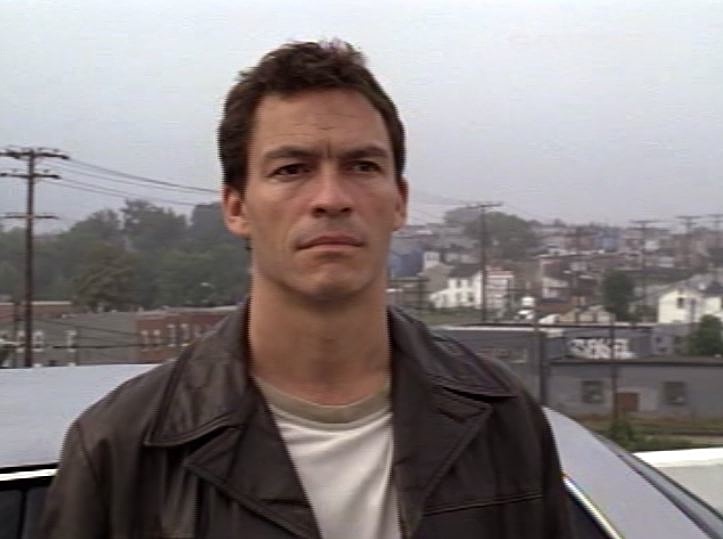
As most of you know, I covered the five seasons of "The Wire" out of order online. I didn't start doing episode-by-episode blogs until the fourth season, so I covered that and season 5 as they aired. Then I looped back around to do season 1 and season 2 on this blog, and when I moved to HitFix, I spent the first summer there covering season 3. Everything is covered, everything is easily linked to, etc., and yet a glitch I've never understood in the Blogspot software means that a few times a month, I have to explain to people where the season 5 reviews are.
For whatever reason, when you click on the link for season 5, it takes you to a page featuring only my series finale review and my post-finale interview with David Simon. Some people know to click on the "Older Posts" link below the Simon interview, and some don't, so to save me some time in the future, I'm making this the first post you'll see when you click on the season 5 link, and I'm including links to all the reviews right here. In order:
Click here to read the full post
Showing posts with label The Wire. Show all posts
Tuesday, June 12, 2012
Friday, June 04, 2010
Where you can go to find my Wire season 3 reviews
Updating an old post for completeness' sake. For a variety of reasons too dull to repeat again, season 3 of "The Wire" is the only year of that show I never covered on this blog, but I'm covering it in my new home at Hitfix. So each week I'll come into this post to add links to find both versions of each reviews, so you'll still be able to find links to every one of my "Wire" reviews in one place. (You can find all the previous reviews along this blog's siderail.) Links coming up after the jump...• Episode 1, "Time After Time": Newbie version & Veteran version
• Episode 2, "All Due Respect": Newbie version & Veteran version
• Episode 3, "Dead Soldiers": Newbie version & Veteran version
• Episode 4, "Hamsterdam": Newbie version & Veteran version
• Episode 5, "Straight and True": Newbie version & Veteran version
• Episode 6, "Homecoming": Newbie version & Veteran version
• Episode 7, "Back Burners": Newbie version & Veteran version
• Episode 8, "Moral Midgetry": Newbie version & Veteran version
• Episode 9, "Slapstick": Newbie version & Veteran version
• Episode 10, "Reformation": Newbie version & Veteran version
• Episode 11, "Middle Ground": Newbie version & Veteran version & George Pelecanos interview
• Episode 12, "Mission Accomplished": Newbie version & Veteran version
"The Wire" is one of the subjects of Alan Sepinwall's new book, "The Revolution Was Televised: The Cops, Crooks, Slingers and Slayers Who Changed TV Drama Forever." It includes fresh material, including new interviews with David Simon and the executives at HBO who greenlit the show. For more information and purchasing links, go to AlanSepinwall.com Click here to read the full post
Friday, August 28, 2009
The Wire, Season 2, Episode 12: "Port in a Storm" (Newbies edition)
And so we've come to the end of our look back at "The Wire" season two, and that means it's the last time (for this summer, anyway) that I'll have to tell you that we're doing this in two slightly different versions: one for people who have watched the entire series and want to discuss it from beginning to end, and one for people who've only gotten through season two (or, at least, haven't made it all the way to the finish line) and don't want to be spoiled. This is the newbie version; click here for the veteran edition.Spoilers for the season two finale, "Port in a Storm," coming up just as soon as I look at a table full of heads...
"The world just keeps turning, right? You guys move onto something new. No one looks back." -Beadie"Always" is a word that comes up several times in "Port in a Storm." The episode's epigraph is of The Greek, amused, telling an airline ticket clerk that his travels are about "Business. Always business." When Prop Joe expresses concern about the dope Vondas is leaving on the docks, Vondas assures him, "Always, there is more." And when Avon is lecturing Stringer about how the rules of business school can't always be applied to the drug business, he tells him, "The street is the street... always."
David Simon (who co-wrote the script with Ed Burns) is a former newspaperman who chooses and uses words carefully. There's a point to that repetition of "always," and that point is driven home in the closing montage(*): There is no changing any of this. No matter how clever or well-meaning the cops might be, there will always be men like The Greek ready to exploit human weakness. There will always be people looking to buy and sell guns, and drugs, and even human beings. There will always be little guys left behind by progress. There will always be toughs and gangsters and soldiers, and there will always be a new case for people like Lester and Bunk to move on to, no matter how hard that is to process for someone as relatively un-jaded as Beadie Russell.
(*) This season's montage brought to you by Steve Earle's "I Feel Alright."
There's a sense of hopelessness throughout "Port in a Storm," which is structured much like season one's finale, "Sentencing." The detail gets some mid-level players, but the big targets get away, and it's clear that our heroes didn't even make a dent in things. The FBI's presence causes more problems than it solves, the death of a key witness (Wallace last year, Frank this year) prevents the detail from getting to the major players, and a talented investigator (first Jimmy, now Beadie) is wasted aimlessly driving a vehicle around the port. And there's also time devoted to setting up the following season's storyline, as Bubbs turns Kima and Jimmy onto Joe and Stringer's new business arrangement.
But in many ways, it's even grimmer than "Sentencing." While it seemed obvious that Frank was walking to his death at the end of "Bad Dreams," we (and Beadie, and the stevedores) still have to get an up close and personal look at his mutilated corpse. (And damn if his eyes don't seem to be looking right at Beadie, even as Chris Bauer is doing a good job of playing dead.) And where the season one montage at least climaxed with a laughing Omar - the one character on the show who follows the rules of more traditional filmed entertainment, and the one allowed to exist outside The Game - sticking up a drug dealer, here we end on a grieving Nick shuffling through the rain, trailed by the U.S. Marshal who's preparing him for a new life far away from the one he's always known.
As I asked last year at this time, why do we watch this show if it's going to give us nothing but tragedy and despair? And as I answered myself, we watch it because it's so profound, and moving, and funny, and well-acted, and thrilling even as we know things aren't going to end well except for the worst of the worst.
This was a controversial season at the time it aired, and it remains one. The port story was such a jarring shift from the drug case of season one. And (don't worry, newbies, I'll be vague here) most of these characters will be ignored, or only seen briefly, in later seasons, creating the sense that this season had little to do with the larger picture of the series.
Me? I love season two. The performances by people like Chris Bauer, Al Brown and James Ransone are among the best the show will feature in roles big or small. Sobotka is one of the more complex characters on a series that prides itself on giving depth to even the worst people (like Vondas' affection for Nick). There are so many standout moments from this year that come to mind when I look back on "The Wire" as a whole, whether it's Ziggy struggling to light his cigarette after killing Double-G, or Frank under the bridge, or Brother Mouzone going all Dirty Harry on Cheese, or Jimmy trying to recreate his car accident.
And whether or not the stevedores factor into the narrative down the road, I think this season is just as important thematically as any other. This is not just a show about drugs, or cops, or gangsters. It's about a city, and it's about America, and it's about showing how the system is letting so many people down, whether they're black dope slingers like Bodie or underemployed white guys like Nick.
But even if you want to focus on the drugs, season two is an essential part of the puzzle. Season one is about how a drug crew operates, and later seasons will show how cops and politicians have failed to adequately deal with the drug problem, how kids grow up to be soldiers, and how the media's failure to cover this (and the public's disinterest in the small bits of coverage) allows the problem to perpetuate itself. Here, meanwhile, we get a sense of how the drugs come into the country in the first place, and how men like Vondas and The Greek enable men like Stringer and Prop Joe. Like the poster says, it's all connected, and even if Nick Sobotka and D'Angelo Barksdale never got to meet before one went into witness protection and the other was killed, their lives were as intertwined as they were parallel to one another.
And because "The Wire" on so many levels is a critique of a purely capitalist society, attention must be paid to a season in which the chief villains represent capitalism at its purest and most cruel. They're fake - Vondas is using an alias, The Greek isn't really Greek, the rosary beads are just an affectation and not something he cares about, etc. - in every way but one: they will do anything and hurt anyone to keep the money rolling in.
Always.
Because I've been on vacation most of this week, and because I've hit a lot of the larger plot and thematic issues in my reviews of the previous episodes, let's move straight to the bullet points:
• Getting back to the idea that Frank's death prevents the detail from nabbing Vondas and The Greek, does it really? I know it seems that way, but even if he had shown up at the detail office the next morning, he doesn't know The Greek's name, nor Vondas' real name, nor does he know what hotel they could be found at. They only discover the correct hotel because Lester and Bunk are able to scare Sergei with the death penalty, and the timetable on them gathering all the evidence to make that work wasn't really affected by Frank's death, was it? Nick gives them the Philly info on the same day Frank would have.
• The focus on the port story meant that some of season one's characters got short shrift. Omar is gone for most of the season's mid-point, and the finale is the first we've seen of Bubbs and Johnny in a long time. Meanwhile, the appearance by Detective-turned-Officer Santangelo leaves Sydnor as the only surviving season one character of note to not pop up at any point this season.
• One minor quibble with the finale, though I acknowledge it's something that had to be glossed over given everything else that was happening: given the difficulty the detail had even finding, let alone tailing, Stringer and Avon a season ago, how did Kima and Jimmy get a tail on Prop Joe and/or Stringer so easily?
• Though Valchek may be the petty bastard who set much of this tragedy in motion, and though his absolution of Prez is tied up in his own pride (the apology letters have to explain that Stan could only be hurt by a sucker punch), he does have a very human moment when he looks at the latest photo of the surveillance van and realizes he did, in fact, have some affection for Frank. Can anybody translate what he says in Polish at the end of that scene?
• Robert Colesberry, the series' lead non-writing producer, made his directorial debut on this episode after a long and distinguished career behind the scenes, but not behind the camera, in movies and TV. As the man whom David Simon credits the most with helping come up with the series' visual style, Colesberry unsurprisingly was a natural in his first stint in the director's chair; I especially love the shot of the stevedores standing over Frank's corpse, and the way Nick's confession to the cops is shot with Frank's photo directly over his shoulder, with the shot shifting focus between the living nephew and the dead uncle at various points. Tragically, Colesberry - who also dabbled in acting on the show as bumbling Homicide veteran Ray Cole - died before season three really got up and running.
• Frank's death, and Ziggy's incarceration, and the disintegration of the union are among the season's bigger tragedies, but on some level I'm just as upset at that shot of Beadie driving aimlessly through the stacks. She went from someone who didn't know or care much about being a real cop to someone who displayed a real talent, and at times passion, for investigation. Emotionally, she's probably better off - the crimes always weighed harder on her than they did on the rest of the detail - but it still seems like a waste.
• I wouldn't call Pablo Schreiber a weak link exactly, but because the show's casting is so uniformly good, and because most of the other actors come across so naturally, Schreiber's more mannered performance as Nick often seemed a half-step out of sync. But the man really brings it in the finale, both with the rage burning in Nick's eyes as he sits in Frank's trailer and thinks about killing Vondas to the anguish on his face as he stands at that fence and contemplates his past and his future.
• As I said when Agent Koutris first appeared, some fans initially believed that he was corrupt. But the idea was always supposed to be that he was an honest agent who had done a moral calculus and decided the intel he thought he was getting from The Greek was worth more than whatever crimes The Greek committed because Koutris kept him on the street. The fact that Fitz is mad at himself, but not at Koutris, once he realizes what happened, suggests that this is just the way things work at the Bureau.
• One of my favorite things about the storytelling style that Simon, Burns and Colesberry created is that they're happy to simply stop and show characters thinking. There's a lovely extra beat after Stringer asks Brother Mouzone who shot him, and you can see the very sharp Brother wondering why Avon's number two is so curious.
• Again, the show is always very fair about seeing multiple sides of issues. Even though it's very clear that the writers are in favor of the patient, cerebral Ed Burns style of policing, and even though Herc and Carver are supposed to represent the reckless, pointless head-busting approach that's largely ruined the Baltimore PD, their frustration at having to play pack mule for the detail is understandable - and funny. I think anyone would be justified in asking for a transfer after spending an entire case doing the scutwork - note who had to do all the hard labor for the warrants judge a few episodes back - and after being left sitting on Nick's house long after Nick had turned himself in to a member of the detail.
• The brief scene at Daniels' home confirms what was already clear back when he assumed responsibilities for the 14 Jane Does in "Backwash." His marriage to Marla is over in everything but name, as he's now sleeping in a spare room and she couldn't possibly be colder to him. The irony, of course, is that Daniels' unit did turn those 14 red names to black, and in the process boosted his standing with Burrell and Rawls, but Marla has already decided that the man running the newly-official Major Crimes Unit is not the man she thought she married.
• The scene where Louis Sobotka shows up at Frank's trailer and tells Nick "Let's go" is a real testament to the economy with which "The Wire" creates characters. Here's a guy who's had only a handful of scenes throughout the season, but we know him (and we know the Sobotka family) well enough by this point that it's a big moment when he tells his son it's time to stop messing around and face the consequences of what he's done.
Well, it's been fun. With any luck, we can finish up the series next summer with a look back through season three, which was the last one to air before I started my second career as a blogger.
What did everybody else think? Click here to read the full post
The Wire, Season 2, Episode 12: "Port in a Storm" (Veterans edition)
And so we've come to the end of our look back at "The Wire" season two, and that means it's the last time (for this summer, anyway) that I'll have to tell you that we're doing this in two slightly different versions: one for people who have watched the entire series and want to discuss it from beginning to end, and one for people who've only gotten through season two (or, at least, haven't made it all the way to the finish line) and don't want to be spoiled. This is the veteran version; click here for the newbie edition.Spoilers for the season two finale, "Port in a Storm," coming up just as soon as I look at a table full of heads...
"The world just keeps turning, right? You guys move onto something new. No one looks back." -Beadie"Always" is a word that comes up several times in "Port in a Storm." The episode's epigraph is of The Greek, amused, telling an airline ticket clerk that his travels are about "Business. Always business." When Prop Joe expresses concern about the dope Vondas is leaving on the docks, Vondas assures him, "Always, there is more." And when Avon is lecturing Stringer about how the rules of business school can't always be applied to the drug business, he tells him, "The street is the street... always."
David Simon (who co-wrote the script with Ed Burns) is a former newspaperman who chooses and uses words carefully. There's a point to that repetition of "always," and that point is driven home in the closing montage(*): There is no changing any of this. No matter how clever or well-meaning the cops might be, there will always be men like The Greek ready to exploit human weakness. There will always be people looking to buy and sell guns, and drugs, and even human beings. There will always be little guys left behind by progress. There will always be toughs and gangsters and soldiers, and there will always be a new case for people like Lester and Bunk to move on to, no matter how hard that is to process for someone as relatively un-jaded as Beadie Russell.
(*) This season's montage brought to you by Steve Earle's "I Feel Alright."
There's a sense of hopelessness throughout "Port in a Storm," which is structured much like season one's finale, "Sentencing." The detail gets some mid-level players, but the big targets get away, and it's clear that our heroes didn't even make a dent in things. The FBI's presence causes more problems than it solves, the death of a key witness (Wallace last year, Frank this year) prevents the detail from getting to the major players, and a talented investigator (first Jimmy, now Beadie) is wasted aimlessly driving a vehicle around the port. And there's also time devoted to setting up the following season's storyline, as Bubbs turns Kima and Jimmy onto Joe and Stringer's new business arrangement.
But in many ways, it's even grimmer than "Sentencing." While it seemed obvious that Frank was walking to his death at the end of "Bad Dreams," we (and Beadie, and the stevedores) still have to get an up close and personal look at his mutilated corpse. (And damn if his eyes don't seem to be looking right at Beadie, even as Chris Bauer is doing a good job of playing dead.) And where the season one montage at least climaxed with a laughing Omar - the one character on the show who follows the rules of more traditional filmed entertainment, and the one allowed to exist outside The Game - sticking up a drug dealer, here we end on a grieving Nick shuffling through the rain, trailed by the U.S. Marshal who's preparing him for a new life far away from the one he's always known.
As I asked last year at this time, why do we watch this show if it's going to give us nothing but tragedy and despair? And as I answered myself, we watch it because it's so profound, and moving, and funny, and well-acted, and thrilling even as we know things aren't going to end well except for the worst of the worst.
This was a controversial season at the time it aired, and it remains one. The port story was such a jarring shift from the drug case of season one. And (don't worry, newbies, I'll be vague here) most of these characters will be ignored, or only seen briefly, in later seasons, creating the sense that this season had little to do with the larger picture of the series.
Me? I love season two. The performances by people like Chris Bauer, Al Brown and James Ransone are among the best the show will feature in roles big or small. Sobotka is one of the more complex characters on a series that prides itself on giving depth to even the worst people (like Vondas' affection for Nick). There are so many standout moments from this year that come to mind when I look back on "The Wire" as a whole, whether it's Ziggy struggling to light his cigarette after killing Double-G, or Frank under the bridge, or Brother Mouzone going all Dirty Harry on Cheese, or Jimmy trying to recreate his car accident.
And whether or not the stevedores factor into the narrative down the road, I think this season is just as important thematically as any other. This is not just a show about drugs, or cops, or gangsters. It's about a city, and it's about America, and it's about showing how the system is letting so many people down, whether they're black dope slingers like Bodie or underemployed white guys like Nick.
But even if you want to focus on the drugs, season two is an essential part of the puzzle. Season one is about how a drug crew operates, and later seasons will show how cops and politicians have failed to adequately deal with the drug problem, how kids grow up to be soldiers, and how the media's failure to cover this (and the public's disinterest in the small bits of coverage) allows the problem to perpetuate itself. Here, meanwhile, we get a sense of how the drugs come into the country in the first place, and how men like Vondas and The Greek enable men like Stringer and Prop Joe. Like the poster says, it's all connected, and even if Nick Sobotka and D'Angelo Barksdale never got to meet before one went into witness protection and the other was killed, their lives were as intertwined as they were parallel to one another.
And because "The Wire" on so many levels is a critique of a purely capitalist society, attention must be paid to a season in which the chief villains represent capitalism at its purest and most cruel. They're fake - Vondas is using an alias, The Greek isn't really Greek, the rosary beads are just an affectation and not something he cares about, etc. - in every way but one: they will do anything and hurt anyone to keep the money rolling in.
Always.
Because I've been on vacation most of this week, and because I've hit a lot of the larger plot and thematic issues in my reviews of the previous episodes, let's move straight to the bullet points:
• Getting back to the idea that Frank's death prevents the detail from nabbing Vondas and The Greek, does it really? I know it seems that way, but even if he had shown up at the detail office the next morning, he doesn't know The Greek's name, nor Vondas' real name, nor does he know what hotel they could be found at. They only discover the correct hotel because Lester and Bunk are able to scare Sergei with the death penalty, and the timetable on them gathering all the evidence to make that work wasn't really affected by Frank's death, was it? Nick gives them the Philly info on the same day Frank would have.
• The focus on the port story meant that some of season one's characters got short shrift. Omar is gone for most of the season's mid-point, and the finale is the first we've seen of Bubbs and Johnny in a long time. Meanwhile, the appearance by Detective-turned-Officer Santangelo leaves Sydnor as the only surviving season one character of note to not pop up at any point this season.
• One minor quibble with the finale, though I acknowledge it's something that had to be glossed over given everything else that was happening: given the difficulty the detail had even finding, let alone tailing, Stringer and Avon a season ago, how did Kima and Jimmy get a tail on Prop Joe and/or Stringer so easily?
• Though Valchek may be the petty bastard who set much of this tragedy in motion, and though his absolution of Prez is tied up in his own pride (the apology letters have to explain that Stan could only be hurt by a sucker punch), he does have a very human moment when he looks at the latest photo of the surveillance van and realizes he did, in fact, have some affection for Frank. Can anybody translate what he says in Polish at the end of that scene?
• Robert Colesberry, the series' lead non-writing producer, made his directorial debut on this episode after a long and distinguished career behind the scenes, but not behind the camera, in movies and TV. As the man whom David Simon credits the most with helping come up with the series' visual style, Colesberry unsurprisingly was a natural in his first stint in the director's chair; I especially love the shot of the stevedores standing over Frank's corpse, and the way Nick's confession to the cops is shot with Frank's photo directly over his shoulder, with the shot shifting focus between the living nephew and the dead uncle at various points. Tragically, Colesberry - who also dabbled in acting on the show as bumbling Homicide veteran Ray Cole - died before season three really got up and running.
• Frank's death, and Ziggy's incarceration, and the disintegration of the union are among the season's bigger tragedies, but on some level I'm just as upset at that shot of Beadie driving aimlessly through the stacks. She went from someone who didn't know or care much about being a real cop to someone who displayed a real talent, and at times passion, for investigation. Emotionally, she's probably better off - the crimes always weighed harder on her than they did on the rest of the detail - but it still seems like a waste.
• I wouldn't call Pablo Schreiber a weak link exactly, but because the show's casting is so uniformly good, and because most of the other actors come across so naturally, Schreiber's more mannered performance as Nick often seemed a half-step out of sync. But the man really brings it in the finale, both with the rage burning in Nick's eyes as he sits in Frank's trailer and thinks about killing Vondas to the anguish on his face as he stands at that fence and contemplates his past and his future.
• As I said when Agent Koutris first appeared, some fans initially believed that he was corrupt. But the idea was always supposed to be that he was an honest agent who had done a moral calculus and decided the intel he thought he was getting from The Greek was worth more than whatever crimes The Greek committed because Koutris kept him on the street. The fact that Fitz is mad at himself, but not at Koutris, once he realizes what happened, suggests that this is just the way things work at the Bureau.
• One of my favorite things about the storytelling style that Simon, Burns and Colesberry created is that they're happy to simply stop and show characters thinking. There's a lovely extra beat after Stringer asks Brother Mouzone who shot him, and you can see the very sharp Brother wondering why Avon's number two is so curious.
• Again, the show is always very fair about seeing multiple sides of issues. Even though it's very clear that the writers are in favor of the patient, cerebral Ed Burns style of policing, and even though Herc and Carver are supposed to represent the reckless, pointless head-busting approach that's largely ruined the Baltimore PD, their frustration at having to play pack mule for the detail is understandable - and funny. I think anyone would be justified in asking for a transfer after spending an entire case doing the scutwork - note who had to do all the hard labor for the warrants judge a few episodes back - and after being left sitting on Nick's house long after Nick had turned himself in to a member of the detail.
• The brief scene at Daniels' home confirms what was already clear back when he assumed responsibilities for the 14 Jane Does in "Backwash." His marriage to Marla is over in everything but name, as he's now sleeping in a spare room and she couldn't possibly be colder to him. The irony, of course, is that Daniels' unit did turn those 14 red names to black, and in the process boosted his standing with Burrell and Rawls, but Marla has already decided that the man running the newly-official Major Crimes Unit is not the man she thought she married.
• The scene where Louis Sobotka shows up at Frank's trailer and tells Nick "Let's go" is a real testament to the economy with which "The Wire" creates characters. Here's a guy who's had only a handful of scenes throughout the season, but we know him (and we know the Sobotka family) well enough by this point that it's a big moment when he tells his son it's time to stop messing around and face the consequences of what he's done.
And for the final time this season, here come some veterans-only thoughts on how the events of this episode will play out through the rest of the series.
• As alluded to above, this is the last we'll see of most of the port characters in any kind of significant role. Beadie gets involved with McNulty, and Vondas and The Greek come back into play with Marlo and Joe in the final season, but aside from brief season five cameos by a now-homeless Johnny 50 and by Nick protesting the opening of new waterfront condos, we're done with these people. And to reiterate a point from that Nick cameo, David Simon told me that the idea was Nick left the witness protection program, as many people do, because he missed his old life; if Vondas or The Greek know he's back in Baltimore, they don't much care, because the case is years old and they feel confident they can get out of town quickly should any new problems arise.
• Vondas' "My name is not my name" line works as the antithesis of Marlo's "My name is my name!" speech from season five, and nicely illustrates the difference between the two organizations. Vondas and The Greek care only for money, where Marlo's primary concern is power and respect. Marlo's name is all he cares about; Vondas' name is just a tool to use so he can remain anonymous and count his cash.
• And getting back to Johnny 50's homeless future, I wonder if Simon and company had that in mind at all with the brief clip during the montage of Lala dragging a plastered Johnny away from a corner. With the union taken over by the feds, with his two best friends either in jail or in witness protection, and with the general level of alcoholism among the stevedores, it's not at all hard to imagine Johnny climbing inside a bottle for a few years and emerging to find himself living in a shanty town.
• The Major Crimes Unit becomes a more or less permanent thing, and will operate out of that off-site building in the Southeastern for the rest of the series' run.
• Once again, we see a police document referring to Cheese's last name as "Flagstaff," when in season four it will become Wagstaff to tie him to unacknowledged son Randy.
• Carver and Herc leave for the Western district, where Carver will learn how to be a good cop from Bunny Colvin, and where Herc will stay ignorant as ever.
Well, it's been fun. With any luck, we can finish up the series next summer with a look back through season three, which was the last one to air before I started my second career as a blogger.
What did everybody else think? Click here to read the full post
Friday, August 21, 2009
The Wire, Season 2, Episode 11: "Bad Dreams" (Newbies edition)
Almost to the finish line on "The Wire" season two, folks. As always, we're going to look back in two slightly different versions: one for the people who are watching the show at roughly the same pace I'm writing about it and don't want to be spoiled on what comes down the road, and one for people who have watched the entire series and want to be able to talk about all of it. This is the newbie version; click here for the veteran edition.Spoilers for "Bad Dreams" coming up just as soon as you get me two hot dogs and a strawberry soda...
"You know what the trouble is, Brucie? We used to make s--t in this country. Build s--t. Now we just put our hand in the next guy's pocket." -Frank SobotkaWhen we get to this point of each season of "The Wire," I tend to rail a lot against the screenwriting crimes committed by George Pelecanos. In season one, he killed off Wallace. Here, he sends Frank Sobotka walking to his apparent doom. In later seasons... well, you veterans are probably already cringing in memory of what Pelecanos did to your favorites.
But it's reductive to single out these penultimate/Pelecanos episodes just because they often (but not always) feature the deaths of beloved characters. Yes, the deaths hit, and they hit hard, but all the non-lethal parts of them hit nearly as hard. This is the point in each season where things that had often seemed like intellectual abstractions start to take on emotional heft - when you see how much misplaced faith Nick has put into his relationship with Vondas, when you see Beadie smile at a job well done in tailing Vondas to his hotel room, when Frank nails Bruce and the state of the American industrial economy to the wall with the line I quoted above.
David Simon likes to compare each season of "The Wire" to a novel, and Pelecanos' episodes always have the sensation of reading the last 70 or 80 pages of a really good thriller - one like, say Pelecanos' own "The Turnaround" or "The Sweet Forever." What may have taken a long time to read in the early going now flies by. You know the players, the conflicts, the stakes, and now you just want to see what happens next, and whether people come to the end you want for them or not(*). So some of the power of these episodes tends to come from their position in the season, but it also comes from the fact that Pelecanos is really, really good at this. Simon has said that in season one, several of the big moments that wound up in Pelecanos' "Cleaning Up" were originally going to be in the Simon-written finale, but George's take on them was so strong that Simon let him handle it.
(*) What's funny is that, for all the talk - including by me - about how Pelecanos and Simon are such kindred literary spirits, his books on average tend to be more optimistic than "The Wire." They're operating on a much smaller scale than what the show is doing - "Drama City," for instance, is what a season of "The Wire" would be like if it were only about Cutty - and not everyone's story turns out as well as they deserve, but the success rate is generally higher, and the overt bad guys (as opposed to the systemic problems) tend to get bumped off in the end. Pelecanos is always much more brutal to Simon's characters than he allows himself to be to his own.
Obviously, the killer sequence here comes at the very end, as Frank's fate is irrevocably changed during the long walk from his truck to where The Greek and Vondas are standing. It's a testament to how well the series has trained its audience that Pelecanos' script and Ernest Dickerson's direction can mine so much tension from a point of view montage of a fax being sent, transferred by mail cart to a secretary, and entered into a computer.
There are shows that try to get a lot of mileage out of springing surprises on their audience - only giving them a small part of the story so their minds can be blown when they find out the whole truth. "The Wire" rarely operates that way. Like the Greek dramas Simon likes to talk about, it tends to lay out everything that's going to happen well before it happens. It doesn't cheat, doesn't hide. It turns you into an omniscient observer of this world, and then it drives you crazy because you know how badly things are going to go, and when you see characters who don't know as much as you do. There are so many moments in "Bad Dreams" alone where I wanted to scream (or have screamed) at the screen, trying to warn characters about fates that in my head I know are unavoidable.
I want to tell Omar not to trust Stringer. I want to scream for Kima to pay attention to the old man in the sweater walking past her in the parking garage. I want to tell Ronnie to not let Sobotka leave the detail office under any circumstance, even if that would require Herc and Carver to entertain him with a song-and-dance number while they waited for Frank's lawyer to show up. And you know I shouted like hell the first time I saw Frank walk toward The Greek, even as I knew the info in Fitz's fax was slowly, inexorably making its way to Agent Koutris' computer.
But it's a TV show, not an interactive experience. Ronnie can't hear me any more than Stan Valchek can listen to reason, and so Frank walks out of the detail office and into the hands of a couple of ruthless international gangsters.
Dammit.
I like that even in this episode, even as Frank is being set up for what looks like a permanent fall, the show allows him the depth that marks him as one of the more complicated characters in the show's history. As Rafael Alvarez said in his comments about "Backwash," "Frank Sobotka was a very smart man who often mistook his heart for his brain." And so the show is allowed to admire Frank's ends - as it does when he puts in a hard day's work in place of Little Big Roy, and as it does when he gives Bruce a piece of his mind - even as Louis Sobotka is invited to cut right through all of Frank's self-rationalizations, and to tell him that trying to save the union doesn't justify turning Louis' son into a drug dealer. (Imagine how angry Louis would be if he knew about the role his brother played in the deaths of the Jane Does.)
An incredible performance throughout the hour, and the season, by Chris Bauer as Sobotka. He's gotten more post-"Wire" work (including his current stint on "True Blood") than someone like Larry Gilliard, but none of those parts have been as rich, as complicated, or as compelling as Frank.
As we did at this point in season one, we see the case coming together, but not as strongly as it should be. Ziggy not only killed off Double-G, he gave The Greek advance warning to clean out both the warehouse and electronics store - the latter because Jay Landsman was too tunnel-visioned to alert Lt. Daniels, or secure the scene, or do anything that might have led the detail closer to those 14 open murders. (To Landsman's credit, he at least recognizes how badly he screwed the pooch, where he wasn't quite as remorseful when he failed to alert Jimmy about a Barksdale-connected murder in season one.) They had Frank in the office, ready and willing to cooperate, but they let him go because Ronnie wasn't stubborn enough to tell Frank to call a lawyer then and there. And thus far, the only person in custody who seems willing to talk is White Mike, who probably wouldn't recognize The Greek any more than Kima did.
It'd be enough to make you cry... if, that is, "The Wire" hadn't already told you that tears won't be enough.
Some other thoughts on "Bad Dreams":
• The other major story of the episode pits our two larger-than-life bad-asses against each other, as Omar buys into Stringer's story and goes after Brother Mouzone, only to realize that the gut-shot man calmly praying to his deity couldn't possibly be the same one who tortured and mutilated Brandon. Though if Omar is savvy enough to see this, why would he believe Stringer in the first place? Butchie could smell something off about things when Joe approached him in the previous episode, and it's not like Stringer didn't have a previous face-to-face opportunity to share this information with Omar.
• The HBO.com recap of this episode takes a literal reading of Ziggy's line about how "the same blood don't flow for us, pop" and suggests that Ziggy is letting Frank know that he knows they're not biological father and son. But there have been enough mistakes in various recaps on that site over the years (on this show and on "The Sopranos") that I don't take them as gospel, and I always viewed that as a metaphor; Frank is Ziggy's father, but Ziggy inherited none of his father's abilities or temperament. Either way, a haunting scene from both Bauer and James Ransone, particularly when Frank has to watch his son walk back into the holding pen and realizes he can't protect the kid anymore from the awful fate he's trapped in. (And it's a fate that Frank set up, by putting Ziggy's cousin and best friend in business with The Greek in the first place.)
• Though nobody on the detail recognizes The Greek (they assume the man in the fancy suit must be the boss), it's still a pleasure to watch Beadie successfully tail Vondas - and, almost as importantly, to see that Bunk and the others trust her to do it. As The Bunk says, she has come a really long way from the clock-puncher we met at the start of the season.
• While The Greek seems to be utterly without emotional attachments (making him more like Stringer), it's interesting to see that number two man Vondas is (like Avon) capable of letting business be complicated by his affection for certain underlings, in this case through his odd surrogate father relationship with Nick.
• Don't blink or you'll miss David Simon as one of the reporters out for Sobotka's perp walk. He's the one shouting out, "Is it just you or is it the whole union?"
• Even amid the tragedy of this one, we get some good nickname-related humor, including Sergei lamenting, "Why always Boris?" and more wacky stevedore nicknames like Big Roy (a small guy) and Little Big Roy (a huge guy).
Coming up next: The season comes to an end with "Port in a Storm," as the detail tries to put a charge on Vondas and The Greek, while Stringer has to deal with the mess he made with Brother Mouzone.
In theory, you'll see that review a week from today. But, as mentioned in several other posts this week, I'm going to be taking some vacation days next week (and will be away for all of the following week), so no promises. Worst comes to worst, you'll get it sometime during that week after Labor Day, when I'll be back at work full-time.
What did everybody else think? Click here to read the full post
The Wire, Season 2, Episode 11: "Bad Dreams" (Veterans edition)
Almost to the finish line on "The Wire" season two, folks. As always, we're going to look back in two slightly different versions: one for the people who are watching the show at roughly the same pace I'm writing about it and don't want to be spoiled on what comes down the road, and one for people who have watched the entire series and want to be able to talk about all of it. This is the veteran version; click here for the newbie edition.Spoilers for "Bad Dreams" coming up just as soon as you get me two hot dogs and a strawberry soda...
"You know what the trouble is, Brucie? We used to make s--t in this country. Build s--t. Now we just put our hand in the next guy's pocket." -Frank SobotkaWhen we get to this point of each season of "The Wire," I tend to rail a lot against the screenwriting crimes committed by George Pelecanos. In season one, he killed off Wallace. Here, he sends Frank Sobotka walking to his apparent doom. In later seasons... well, you veterans are probably already cringing in memory of what Pelecanos did to your favorites.
But it's reductive to single out these penultimate/Pelecanos episodes just because they often (but not always) feature the deaths of beloved characters. Yes, the deaths hit, and they hit hard, but all the non-lethal parts of them hit nearly as hard. This is the point in each season where things that had often seemed like intellectual abstractions start to take on emotional heft - when you see how much misplaced faith Nick has put into his relationship with Vondas, when you see Beadie smile at a job well done in tailing Vondas to his hotel room, when Frank nails Bruce and the state of the American industrial economy to the wall with the line I quoted above.
David Simon likes to compare each season of "The Wire" to a novel, and Pelecanos' episodes always have the sensation of reading the last 70 or 80 pages of a really good thriller - one like, say Pelecanos' own "The Turnaround" or "The Sweet Forever." What may have taken a long time to read in the early going now flies by. You know the players, the conflicts, the stakes, and now you just want to see what happens next, and whether people come to the end you want for them or not(*). So some of the power of these episodes tends to come from their position in the season, but it also comes from the fact that Pelecanos is really, really good at this. Simon has said that in season one, several of the big moments that wound up in Pelecanos' "Cleaning Up" were originally going to be in the Simon-written finale, but George's take on them was so strong that Simon let him handle it.
(*) What's funny is that, for all the talk - including by me - about how Pelecanos and Simon are such kindred literary spirits, his books on average tend to be more optimistic than "The Wire." They're operating on a much smaller scale than what the show is doing - "Drama City," for instance, is what a season of "The Wire" would be like if it were only about Cutty - and not everyone's story turns out as well as they deserve, but the success rate is generally higher, and the overt bad guys (as opposed to the systemic problems) tend to get bumped off in the end. Pelecanos is always much more brutal to Simon's characters than he allows himself to be to his own.
Obviously, the killer sequence here comes at the very end, as Frank's fate is irrevocably changed during the long walk from his truck to where The Greek and Vondas are standing. It's a testament to how well the series has trained its audience that Pelecanos' script and Ernest Dickerson's direction can mine so much tension from a point of view montage of a fax being sent, transferred by mail cart to a secretary, and entered into a computer.
There are shows that try to get a lot of mileage out of springing surprises on their audience - only giving them a small part of the story so their minds can be blown when they find out the whole truth. "The Wire" rarely operates that way. Like the Greek dramas Simon likes to talk about, it tends to lay out everything that's going to happen well before it happens. It doesn't cheat, doesn't hide. It turns you into an omniscient observer of this world, and then it drives you crazy because you know how badly things are going to go, and when you see characters who don't know as much as you do. There are so many moments in "Bad Dreams" alone where I wanted to scream (or have screamed) at the screen, trying to warn characters about fates that in my head I know are unavoidable.
I want to tell Omar not to trust Stringer. I want to scream for Kima to pay attention to the old man in the sweater walking past her in the parking garage. I want to tell Ronnie to not let Sobotka leave the detail office under any circumstance, even if that would require Herc and Carver to entertain him with a song-and-dance number while they waited for Frank's lawyer to show up. And you know I shouted like hell the first time I saw Frank walk toward The Greek, even as I knew the info in Fitz's fax was slowly, inexorably making its way to Agent Koutris' computer.
But it's a TV show, not an interactive experience. Ronnie can't hear me any more than Stan Valchek can listen to reason, and so Frank walks out of the detail office and into the hands of a couple of ruthless international gangsters.
Dammit.
I like that even in this episode, even as Frank is being set up for what looks like a permanent fall, the show allows him the depth that marks him as one of the more complicated characters in the show's history. As Rafael Alvarez said in his comments about "Backwash," "Frank Sobotka was a very smart man who often mistook his heart for his brain." And so the show is allowed to admire Frank's ends - as it does when he puts in a hard day's work in place of Little Big Roy, and as it does when he gives Bruce a piece of his mind - even as Louis Sobotka is invited to cut right through all of Frank's self-rationalizations, and to tell him that trying to save the union doesn't justify turning Louis' son into a drug dealer. (Imagine how angry Louis would be if he knew about the role his brother played in the deaths of the Jane Does.)
An incredible performance throughout the hour, and the season, by Chris Bauer as Sobotka. He's gotten more post-"Wire" work (including his current stint on "True Blood") than someone like Larry Gilliard, but none of those parts have been as rich, as complicated, or as compelling as Frank.
As we did at this point in season one, we see the case coming together, but not as strongly as it should be. Ziggy not only killed off Double-G, he gave The Greek advance warning to clean out both the warehouse and electronics store - the latter because Jay Landsman was too tunnel-visioned to alert Lt. Daniels, or secure the scene, or do anything that might have led the detail closer to those 14 open murders. (To Landsman's credit, he at least recognizes how badly he screwed the pooch, where he wasn't quite as remorseful when he failed to alert Jimmy about a Barksdale-connected murder in season one.) They had Frank in the office, ready and willing to cooperate, but they let him go because Ronnie wasn't stubborn enough to tell Frank to call a lawyer then and there. And thus far, the only person in custody who seems willing to talk is White Mike, who probably wouldn't recognize The Greek any more than Kima did.
It'd be enough to make you cry... if, that is, "The Wire" hadn't already told you that tears won't be enough.
Some other thoughts on "Bad Dreams":
• The other major story of the episode pits our two larger-than-life bad-asses against each other, as Omar buys into Stringer's story and goes after Brother Mouzone, only to realize that the gut-shot man calmly praying to his deity couldn't possibly be the same one who tortured and mutilated Brandon. Though if Omar is savvy enough to see this, why would he believe Stringer in the first place? Butchie could smell something off about things when Joe approached him in the previous episode, and it's not like Stringer didn't have a previous face-to-face opportunity to share this information with Omar.
• The HBO.com recap of this episode takes a literal reading of Ziggy's line about how "the same blood don't flow for us, pop" and suggests that Ziggy is letting Frank know that he knows they're not biological father and son. But there have been enough mistakes in various recaps on that site over the years (on this show and on "The Sopranos") that I don't take them as gospel, and I always viewed that as a metaphor; Frank is Ziggy's father, but Ziggy inherited none of his father's abilities or temperament. Either way, a haunting scene from both Bauer and James Ransone, particularly when Frank has to watch his son walk back into the holding pen and realizes he can't protect the kid anymore from the awful fate he's trapped in. (And it's a fate that Frank set up, by putting Ziggy's cousin and best friend in business with The Greek in the first place.)
• Though nobody on the detail recognizes The Greek (they assume the man in the fancy suit must be the boss), it's still a pleasure to watch Beadie successfully tail Vondas - and, almost as importantly, to see that Bunk and the others trust her to do it. As The Bunk says, she has come a really long way from the clock-puncher we met at the start of the season.
• While The Greek seems to be utterly without emotional attachments (making him more like Stringer), it's interesting to see that number two man Vondas is (like Avon) capable of letting business be complicated by his affection for certain underlings, in this case through his odd surrogate father relationship with Nick.
• Don't blink or you'll miss David Simon as one of the reporters out for Sobotka's perp walk. He's the one shouting out, "Is it just you or is it the whole union?"
• Even amid the tragedy of this one, we get some good nickname-related humor, including Sergei lamenting, "Why always Boris?" and more wacky stevedore nicknames like Big Roy (a small guy) and Little Big Roy (a huge guy).
And now we've come to the veterans-only part of the review, where we talk about how events in this episode will play out in the finale, and over the course of the series:
• Sergei will again have to suffer being called "Boris" by Marlo in season five, though as I said at the time, I felt that was an attempt at stretching out a running gag at the expense of character, as Marlo doesn't seem the type to be aware of the existence of "Rocky & Bullwinkle," let alone Boris Badenov or any other stereotypes about Russia.
• As Nick learns in the finale, Frank was a fool to listen to Vondas' pitch, because there's no way he could have made Ziggy's confession go away. That does raise the question of what would have happened without Koutris' urgent call. Maybe Frank survives that initial meet under the bridge, but Vondas gets to him once he realizes they can't make the case go away.
• Stringer, of course, has gotten far too cute with Omar and Brother Mouzone, and that will come back to bite him in season three - while leading to the greatest superhero team-up since Superman and Spider-Man took on Doctor Doom and the Parasite. In retrospect, I wonder how things would have gone down had Stringer just bluntly told Avon, "Look. You're in here. I'm out in the real world. I see how things are going. Muscle, even Brother Mouzone's muscle, isn't going to solve our long-term problem, because everybody knows we've got no product, and the only person willing to sell it to us is Joe. I've just arranged to make us a ton of money, and if you have a problem with that, we can talk about it after you've gotten out and I've handed you your cut." Or would that have just ended the partnership even sooner? It's "The Wire." You can't change the fates. I just really want to sometimes.
Coming up next: The season comes to an end with "Port in a Storm," as the detail tries to put a charge on Vondas and The Greek, while Stringer has to deal with the mess he made with Brother Mouzone.
In theory, you'll see that review a week from today. But, as mentioned in several other posts this week, I'm going to be taking some vacation days next week (and will be away for all of the following week), so no promises. Worst comes to worst, you'll get it sometime during that week after Labor Day, when I'll be back at work full-time.
What did everybody else think? Click here to read the full post
Friday, August 14, 2009
The Wire, Season 2, Episode 10: "Storm Warnings" (Newbies edition)
Okay, press tour's over, and we've got three episodes of "The Wire" season two left to re-visit. As always, we're doing this in two versions: one for people who have watched the whole series from beginning to end and want to talk about this episode in the context of what's to come, and one for people who don't want later episodes/seasons spoiled for them. This is the newbie edition; click here for the veteran version.Spoilers for episode ten, "Storm Warnings," coming up just as soon as you get me my copy of Harper's...
"He wasn't saying 'Please don't shoot me.' He was more... begging." -Ziggy"The Wire" season two aired back when I was still teamed up on the TV beat with the great Matt Zoller Seitz, and I remember him coming into work the morning after he had watched "Storm Warnings" raving about the sequence where Ziggy murders Double-G and stumbles back to his car.
"That," he said, "was like a Springsteen song come to life."
For all the grief that Ziggy takes from "Wire" viewers, new and old, for being so pathetic, that sequence wouldn't be half as powerful without all the past humiliations we'd witnessed. If Ziggy wasn't terrible at everything - if he wasn't constantly being laughed at, and dismissed, and shouted down - then it doesn't make sense that he would snap like this, killing one man, wounding another, and throwing his own life down the drain. But because Ziggy has been the lifelong butt of a cosmic joke, because we've seen his frustrations mount as he's failed at living up to his father and his cousin, we understand how he gets to this breaking point when Double-G shorts him on the money and then laughs at (and gut punches) him. Ziggy has always bottled up his anger, and has always been prone to rash decisions (fighting Maui, buying the duck), and with a gun in his hand(*), he makes another one that he can't undo. The duck's not coming back, but nobody really cares about the duck. George Glekas, on the other hand? Ziggy has to answer for that, and he knows it, and in one final understandably screwed-up decision, Ziggy embraces the deed, so long as the official record makes it sound like Glekas was the coward begging for his life, and Ziggy was the bad, bad man who put him down.
(*) A gun that, as I pointed out in the previous veterans edition, he was only in a position to buy because Double-G wouldn't front him some cash for the theft and Ziggy had to go pawn the duck's necklace.
I don't know that James Ransone ever got the credit he deserved for being so convincing as such a deliberately irritating character(**). But watch a scene like Ziggy struggling to light his cigarette, or an empty Ziggy giving a disbelieving Jay Landsman exactly what he needs because there's no point in fighting the tide, and you can see that this is one of the most indelible performances of the season, if not the series.
(**) Though his work in "Generation Kill" as chatterbox Ray Person seemed to help. I remember reading a lot of "I had no idea this guy was a good actor" comments last summer.
Ziggy's rampage is the most noteworthy event in "Storm Warnings," but the episode as a whole is incredibly busy, moving the plot along more than in the previous weeks combined. It's so busy, in fact, that it opens with a quasi-break from the show's usual rules about music and editing, as we see the detail's investigation take several leaps forward in a montage scored to Johnny Cash's "Walk the Line." Because Prez puts that song on his portable stereo at the start of the montage, and because the montage is depicting the various developments that Prez is logging on the case board, it's more bending the rules than breaking them. But as with most seasons of the show, you get the sense that David Simon and Ed Burns are more interested in setting up the plot than in actually showing the plot -- that it's more important to them, from a character and a thematic perspective, to show the growing pains of a project than to dwell on the period when things are working smoothly -- which is why we get an episode like this nearly every season. And at times, so much is happening that a montage is the only way to show it all.
Yet "Storm Warnings" never feels especially rushed. We still linger on Ziggy's dazed point of view as he stumbles out of Double-G's shop, still get the long pause as Lester and Bunk jokingly stare down the feds, still get to hear Brother Mouzone deliver his whole Dirty Harry monologue to Cheese, still get to see Nick and Prissy Catlow getting drunk at the playground and crying as they swap Ziggy stories.
To fit all of this in - in terms of both time and tone - Burns and director Rob Bailey take more stylistic liberties than we usually get on a series where each episode more or less looks and feels like every other. In addition to the Johnny Cash montage, Ziggy's stumble back to his car is shot in an impressionist style where the series usually strives for documentary realism, and the playground scene feels oddly stage-bound, as if Nick and Prissy had briefly wandered into a Tennessee Williams play. I'm enough of a "Wire" purist to note the departures from the usual form, but not enough of one to be irked that this episode features so many of them.
After all, what show other than "The Wire" could end an episode with the good guys furiously typing even as we see the bad guys destroying most of the evidence our heroes are trying to obtain?
Some other thoughts on "Storm Warnings":
• Because "The Wire" loves its parallel structures, "Storm Warnings" offers us a second surprise explosion from a dorky supporting character, as Prez clocks Valchek in front of Daniels, Lester and half the Baltimore FBI field office. As with Ziggy, Prez's outburst has been a long time in coming - we've seen from the second scene of the season premiere that Valchek has no interest in listening to what his son-in-law thinks about policework - and while the result of this one isn't quite as permanent as what Ziggy does to Double-G, we know from this season that Stan Valchek is a man who knows how to hold - and pursue - a grudge.
• And how hilarious is that shot of Lance Reddick's eyes bugging out at the sight of Prez's punch? For that matter, is there a phrase on this show, other than McNulty's "What the f--k did I do?," that comes up as often, and in so many different and amusing circumstances, as hearing Daniels seething as he utters the words "Detective, my office"?
• There were some complaints in the last review that Brother Mouzone's arrival gave the series one larger-than-life character too many, and his assault on Cheese - which, again, is an homage to the most iconic scene of Clint Eastwood's career - certainly keeps him operating on a different frequency of reality than anyone on the show other than Omar.
• And speaking of Omar, we not only learn that he's tight with Blind Butchie, who operates as Omar's bank, but that Prop Joe is aware of this relationship and wants to use it to deal with the Brother Mouzone problem.
• Brother Mouzone is played by Michael Potts, one of many "Wire" actors who's so memorable in the role (and was so unknown to me beforehand) that it becomes impossible for me to see him in another role (say, on "Flight of the Conchords" as Joseph Saladou, the one Nigerian on the Internet whose request for money isn't a scam) without immediately flashing on him lecturing Cheese about the "copper-jacketed hollow point 120 grain hot streak load of my own creation." Also, Mouzone's sidekick Lamar is played by DeAndre McCullough, who was one of the main characters of Simon and Burns' non-fiction epic "The Corner." (Sean Nelson played him in "The Corner" miniseries.)
• Prissy is played by Merritt Wever, currently one of the funniest people on television as nurse-in-training Zoey on Showtime's "Nurse Jackie."
Coming up next: "Bad Dreams," the penultimate episode of season two, which means two things: George Pelecanos on script, and a whole lotta tragedy. Hopefully, we can stay on the Friday schedule for these final few weeks.
What did everybody else think? Click here to read the full post
The Wire, Season 2, Episode 10: "Storm Warnings" (Veterans edition)
Okay, press tour's over, and we've got three episodes of "The Wire" season two left to re-visit. As always, we're doing this in two versions: one for people who have watched the whole series from beginning to end and want to talk about this episode in the context of what's to come, and one for people who don't want later episodes/seasons spoiled for them. This is the veteran edition; click here for the newbie version.Spoilers for episode ten, "Storm Warnings," coming up just as soon as you get me my copy of Harper's...
"He wasn't saying 'Please don't shoot me.' He was more... begging." -Ziggy"The Wire" season two aired back when I was still teamed up on the TV beat with the great Matt Zoller Seitz, and I remember him coming into work the morning after he had watched "Storm Warnings" raving about the sequence where Ziggy murders Double-G and stumbles back to his car.
"That," he said, "was like a Springsteen song come to life."
For all the grief that Ziggy takes from "Wire" viewers, new and old, for being so pathetic, that sequence wouldn't be half as powerful without all the past humiliations we'd witnessed. If Ziggy wasn't terrible at everything - if he wasn't constantly being laughed at, and dismissed, and shouted down - then it doesn't make sense that he would snap like this, killing one man, wounding another, and throwing his own life down the drain. But because Ziggy has been the lifelong butt of a cosmic joke, because we've seen his frustrations mount as he's failed at living up to his father and his cousin, we understand how he gets to this breaking point when Double-G shorts him on the money and then laughs at (and gut punches) him. Ziggy has always bottled up his anger, and has always been prone to rash decisions (fighting Maui, buying the duck), and with a gun in his hand(*), he makes another one that he can't undo. The duck's not coming back, but nobody really cares about the duck. George Glekas, on the other hand? Ziggy has to answer for that, and he knows it, and in one final understandably screwed-up decision, Ziggy embraces the deed, so long as the official record makes it sound like Glekas was the coward begging for his life, and Ziggy was the bad, bad man who put him down.
(*) A gun that, as I pointed out in the previous veterans edition, he was only in a position to buy because Double-G wouldn't front him some cash for the theft and Ziggy had to go pawn the duck's necklace.
I don't know that James Ransone ever got the credit he deserved for being so convincing as such a deliberately irritating character(**). But watch a scene like Ziggy struggling to light his cigarette, or an empty Ziggy giving a disbelieving Jay Landsman exactly what he needs because there's no point in fighting the tide, and you can see that this is one of the most indelible performances of the season, if not the series.
(**) Though his work in "Generation Kill" as chatterbox Ray Person seemed to help. I remember reading a lot of "I had no idea this guy was a good actor" comments last summer.
Ziggy's rampage is the most noteworthy event in "Storm Warnings," but the episode as a whole is incredibly busy, moving the plot along more than in the previous weeks combined. It's so busy, in fact, that it opens with a quasi-break from the show's usual rules about music and editing, as we see the detail's investigation take several leaps forward in a montage scored to Johnny Cash's "Walk the Line." Because Prez puts that song on his portable stereo at the start of the montage, and because the montage is depicting the various developments that Prez is logging on the case board, it's more bending the rules than breaking them. But as with most seasons of the show, you get the sense that David Simon and Ed Burns are more interested in setting up the plot than in actually showing the plot -- that it's more important to them, from a character and a thematic perspective, to show the growing pains of a project than to dwell on the period when things are working smoothly -- which is why we get an episode like this nearly every season. And at times, so much is happening that a montage is the only way to show it all.
Yet "Storm Warnings" never feels especially rushed. We still linger on Ziggy's dazed point of view as he stumbles out of Double-G's shop, still get the long pause as Lester and Bunk jokingly stare down the feds, still get to hear Brother Mouzone deliver his whole Dirty Harry monologue to Cheese, still get to see Nick and Prissy Catlow getting drunk at the playground and crying as they swap Ziggy stories.
To fit all of this in - in terms of both time and tone - Burns and director Rob Bailey take more stylistic liberties than we usually get on a series where each episode more or less looks and feels like every other. In addition to the Johnny Cash montage, Ziggy's stumble back to his car is shot in an impressionist style where the series usually strives for documentary realism, and the playground scene feels oddly stage-bound, as if Nick and Prissy had briefly wandered into a Tennessee Williams play. I'm enough of a "Wire" purist to note the departures from the usual form, but not enough of one to be irked that this episode features so many of them.
After all, what show other than "The Wire" could end an episode with the good guys furiously typing even as we see the bad guys destroying most of the evidence our heroes are trying to obtain?
Some other thoughts on "Storm Warnings":
• Because "The Wire" loves its parallel structures, "Storm Warnings" offers us a second surprise explosion from a dorky supporting character, as Prez clocks Valchek in front of Daniels, Lester and half the Baltimore FBI field office. As with Ziggy, Prez's outburst has been a long time in coming - we've seen from the second scene of the season premiere that Valchek has no interest in listening to what his son-in-law thinks about policework - and while the result of this one isn't quite as permanent as what Ziggy does to Double-G, we know from this season that Stan Valchek is a man who knows how to hold - and pursue - a grudge.
• And how hilarious is that shot of Lance Reddick's eyes bugging out at the sight of Prez's punch? For that matter, is there a phrase on this show, other than McNulty's "What the f--k did I do?," that comes up as often, and in so many different and amusing circumstances, as hearing Daniels seething as he utters the words "Detective, my office"?
• There were some complaints in the last review that Brother Mouzone's arrival gave the series one larger-than-life character too many, and his assault on Cheese - which, again, is an homage to the most iconic scene of Clint Eastwood's career - certainly keeps him operating on a different frequency of reality than anyone on the show other than Omar.
• And speaking of Omar, we not only learn that he's tight with Blind Butchie, who operates as Omar's bank, but that Prop Joe is aware of this relationship and wants to use it to deal with the Brother Mouzone problem.
• Brother Mouzone is played by Michael Potts, one of many "Wire" actors who's so memorable in the role (and was so unknown to me beforehand) that it becomes impossible for me to see him in another role (say, on "Flight of the Conchords" as Joseph Saladou, the one Nigerian on the Internet whose request for money isn't a scam) without immediately flashing on him lecturing Cheese about the "copper-jacketed hollow point 120 grain hot streak load of my own creation." Also, Mouzone's sidekick Lamar is played by DeAndre McCullough, who was one of the main characters of Simon and Burns' non-fiction epic "The Corner." (Sean Nelson played him in "The Corner" miniseries.)
• Prissy is played by Merritt Wever, currently one of the funniest people on television as nurse-in-training Zoey on Showtime's "Nurse Jackie."
And now, a few veteran-only thoughts on how the events of this episode will play out over the course of this season:
• You can look at Double-G's murder as a parallel to when Omar shot Stinkum and ruined a lot of hard work by the detail, but next week we'll learn that the crucial mistake was made by Jay Landsman in not alerting the detail to this event so they could secure and search the store. Had Glekas not been killed, Vondas' people still would have emptied the place.
• Or, if you prefer, the real mistake - not that anyone realized it at the time - was in letting the FBI in on the investigation, which in turn alerted Agent Koutris, who alerted The Greek, etc., etc.
• Herc and Carver are nearly at their own breaking point about being low men on the totem pole, and of course that will lead them to transfer to the Western district, where Carver will become a good cop and Herc will become... the same idiot he always was, but now a dangerous one who destroys Randy's life.
• It's pretty clear by this point that Kima and Cheryl's relationship is doomed, as Cheryl practically has to cuff Kima's hand to her own to get Kima to feel the baby kick.
• As with the blinding of Kevin Johnson in season one, Daniels will bail out Prez for the punch. And now as then, Prez - who will stay on the detail until he accidentally kills an undercover cop - probably would have been better off had Daniels stepped aside and let Prez ruin his own career.
Coming up next: "Bad Dreams," the penultimate episode of season two, which means two things: George Pelecanos on script, and a whole lotta tragedy. Hopefully, we can stay on the Friday schedule for these final few weeks.
What did everybody else think? Click here to read the full post
Tuesday, July 28, 2009
The Wire, Season 2, Episode 9: "Stray Rounds" (Newbies edition)
We're in the home stretch on our trip back through season two of "The Wire," and as always, we're doing it in two slightly different versions: one for people who have never seen the show before, and one for people who want to be able to discuss not only season two, but everything that's coming later. This is the newbie version; click here for the veteran edition. Spoilers for episode 9, "Stray Rounds," coming up just as soon as I say "No thank you" to drugs...
"This is about Frank Sobotka!" -Valchek"Stray Rounds" contains one of my absolute favorite scenes in the run of the series, the one quoted above: Daniels and Pearlman brief Burrell and Valchek on everything that the detail has accomplished -- all these near-miraculous feats of investigative genius, having taken what was a simple petty grudge and used it to get a line on smuggling, drugs, prostitution and possibly 14 open murder cases -- and all Stan wants to hear about is Frank Sobotka.
"The case is bigger now." -Pearlman
This, in a nutshell, is why nothing ever gets done in the universe of "The Wire." Good work is damned hard to do, and if it doesn't help someone in power either stay in power or protect his own interests, then it doesn't really matter, does it? Daniels could close the 14 open murders, could nail the entire Barksdale/Bell gang, could find a way to put a charge on the Irsay family for moving the Colts out of Baltimore, and none of it would matter to Valchek if Frank Sobotka weren't charged as an accessory to it all.
There's a lot of hopeless, myopic, institutionalized thinking going on in "Stray Rounds." Bodie's shoot-out with the rival crew kills a little boy, and though Major Bunny Colvin, commander of the Western District, knows the usual War on Drugs tactics are pointless, Rawls tells him to go bust heads and take doors anyway. Norris and Cole assume Bodie is another idiot drug dealer, and so they fall into the trap they think they've set for him. Avon refuses to see Stringer's persuasive arguments about the Prop Joe deal, and instead arranges to hire legendary enforcer Brother Mouzone (and gets him down to Baltimore much quicker than String was expecting). And we see that The Greek is stringing along an FBI agent named Koutris by pretending to give him "terrorists" (actually, a difficult business partner) in exchange for being informed about threats to The Greek's business.
Hell, Ziggy even manages to get his duck to drink itself to death, because it never occurred to him that giving booze to a waterfowl was a health risk.
If it wasn't for McNulty's latest R-rated shenanigans -- or for the joyful performances of people like Al Brown as Valchek and J.D. Williams as Bodie -- this would be one of the darker hours of "The Wire" in which no major character actually dies.
Part of the reason "Stray Rounds" feels so hopeless, of course, is that it's our closest look to date at The Greek and his operation. While the smoke-filled dinner with The Greek and his lieutenants could resemble a gathering of the Injustice League, "The Wire" isn't interested in concepts like good and evil. The Greek does terrible things, but not out of malice -- or even out of the pride that leads to so many terrible outcomes in the drug world (like Bodie and company's stray round). Rather, as David Simon has said many times, The Greek is capitalism in its purest, most ruthless form -- a man who will do anything to keep his business viable, and the money flowing in.
While he and Vondas have their blind spots -- they're a bit too confident about being able to elude the Baltimore PD -- he's still clever enough to recognize what Fitz told Jimmy in the series premiere about the FBI abandoning the War on Drugs for the War on Terror. He has Koutris on the line, not because Koutris is corrupt, but because he's made Koutris believe he can give him information on terrorists, and Koutris has no idea that he's being played.
Against a man with that long a view, with his finger in so many pies, what chance does the detail have to make a case? And against a generation of Bodies and Avons, what chance do men like Bunny Colvin have to make a dent in the human cost of the drug trade?
Some other thoughts on "Stray Rounds":
• Maybe the most heartbreaking part of the opening sequence isn't the mom finding her dead son (though that's brutal), but the moment right before, when she has no idea what's happened and is just telling him to get to school, because the drama's over -- as if this sort of thing happens so often in the neighborhood that they treat it like just another of life's routine inconveniences.
• As if to symbolize the Valchek/Pearlman exchange, Frank is largely spectator in this one, showing up only to witness Koutris' raid on the can with the Colombian drugs, but we do learn that his plan seems to be working, as the new budget will include concessions for the port.
• McNulty is pure comedy in this one, from Dominic West -- a Brit whose American accent is sometimes spotty -- having to do a fake horrible British accent, to the reactions of McNulty and Kima at his situation during the raid, to the flare of Ronnie's eyes when she reads the incident report over Jimmy's shoulder.
• Speaking of the raid, there's a nice small moment where the uniform officer assumes that the only way to take a door is to knock it in, where both Kima and Bunk realize they can just knock and get the same result. This isn't a drug house; you can't flush hookers.
• Herc and Carver have been getting the short end of every assignment all season (down to washing windows in the previous episode), and their frustration is starting to overwhelm them at this point.
• I love the way Frankie Faison plays Burrell in the scene with Valchek, because Erv knows exactly the position Stan is in, having previous assigned Daniels to a detail that sprawled far beyond what was expected.
• We can talk more about Brother Mouzone next time, but note that the character is given the kind of dramatic entrance "The Wire" doesn't usually do -- that is, unless the series' other larger-than-life character, Omar, is involved.
• Bunny Colvin's mustachioed sidekick is Lt. Mello, played by the real-life Jay Landsman, who was the inspiration for both the character of the same name played on "The Wire" by Delaney Williams, but Detective Munch on "Homicide." He has one of the thicker (and authentic) Baltimore accents on the series.
Coming up next: "Storm Warnings," in which Brother Mouzone asks Cheese a question, Valchek makes a federal case out of Sobotka, and Ziggy gets pushed around again.
Not sure when that review will go up, as I used my last free evening before the start of press tour to write this one. Could be next week, could be a few weeks. But it'll get done.
What did everybody else think? Click here to read the full post
The Wire, Season 2, Episode 9: "Stray Rounds" (Veterans edition)
We're in the home stretch on our trip back through season two of "The Wire," and as always, we're doing it in two slightly different versions: one for people who have never seen the show before, and one for people who want to be able to discuss not only season two, but everything that's coming later. This is the veterans version; click here for the newbie edition. Spoilers for episode 9, "Stray Rounds," coming up just as soon as I say "No thank you" to drugs...
"This is about Frank Sobotka!" -Valchek"Stray Rounds" contains one of my absolute favorite scenes in the run of the series, the one quoted above: Daniels and Pearlman brief Burrell and Valchek on everything that the detail has accomplished -- all these near-miraculous feats of investigative genius, having taken what was a simple petty grudge and used it to get a line on smuggling, drugs, prostitution and possibly 14 open murder cases -- and all Stan wants to hear about is Frank Sobotka.
"The case is bigger now." -Pearlman
This, in a nutshell, is why nothing ever gets done in the universe of "The Wire." Good work is damned hard to do, and if it doesn't help someone in power either stay in power or protect his own interests, then it doesn't really matter, does it? Daniels could close the 14 open murders, could nail the entire Barksdale/Bell gang, could find a way to put a charge on the Irsay family for moving the Colts out of Baltimore, and none of it would matter to Valchek if Frank Sobotka weren't charged as an accessory to it all.
There's a lot of hopeless, myopic, institutionalized thinking going on in "Stray Rounds." Bodie's shoot-out with the rival crew kills a little boy, and though Major Bunny Colvin, commander of the Western District, knows the usual War on Drugs tactics are pointless, Rawls tells him to go bust heads and take doors anyway. Norris and Cole assume Bodie is another idiot drug dealer, and so they fall into the trap they think they've set for him. Avon refuses to see Stringer's persuasive arguments about the Prop Joe deal, and instead arranges to hire legendary enforcer Brother Mouzone (and gets him down to Baltimore much quicker than String was expecting). And we see that The Greek is stringing along an FBI agent named Koutris by pretending to give him "terrorists" (actually, a difficult business partner) in exchange for being informed about threats to The Greek's business.
Hell, Ziggy even manages to get his duck to drink itself to death, because it never occurred to him that giving booze to a waterfowl was a health risk.
If it wasn't for McNulty's latest R-rated shenanigans -- or for the joyful performances of people like Al Brown as Valchek and J.D. Williams as Bodie -- this would be one of the darker hours of "The Wire" in which no major character actually dies.
Part of the reason "Stray Rounds" feels so hopeless, of course, is that it's our closest look to date at The Greek and his operation. While the smoke-filled dinner with The Greek and his lieutenants could resemble a gathering of the Injustice League, "The Wire" isn't interested in concepts like good and evil. The Greek does terrible things, but not out of malice -- or even out of the pride that leads to so many terrible outcomes in the drug world (like Bodie and company's stray round). Rather, as David Simon has said many times, The Greek is capitalism in its purest, most ruthless form -- a man who will do anything to keep his business viable, and the money flowing in.
While he and Vondas have their blind spots -- they're a bit too confident about being able to elude the Baltimore PD -- he's still clever enough to recognize what Fitz told Jimmy in the series premiere about the FBI abandoning the War on Drugs for the War on Terror. He has Koutris on the line, not because Koutris is corrupt, but because he's made Koutris believe he can give him information on terrorists, and Koutris has no idea that he's being played.
Against a man with that long a view, with his finger in so many pies, what chance does the detail have to make a case? And against a generation of Bodies and Avons, what chance do men like Bunny Colvin have to make a dent in the human cost of the drug trade?
Some other thoughts on "Stray Rounds":
• Maybe the most heartbreaking part of the opening sequence isn't the mom finding her dead son (though that's brutal), but the moment right before, when she has no idea what's happened and is just telling him to get to school, because the drama's over -- as if this sort of thing happens so often in the neighborhood that they treat it like just another of life's routine inconveniences.
• As if to symbolize the Valchek/Pearlman exchange, Frank is largely spectator in this one, showing up only to witness Koutris' raid on the can with the Colombian drugs, but we do learn that his plan seems to be working, as the new budget will include concessions for the port.
• McNulty is pure comedy in this one, from Dominic West -- a Brit whose American accent is sometimes spotty -- having to do a fake horrible British accent, to the reactions of McNulty and Kima at his situation during the raid, to the flare of Ronnie's eyes when she reads the incident report over Jimmy's shoulder.
• Speaking of the raid, there's a nice small moment where the uniform officer assumes that the only way to take a door is to knock it in, where both Kima and Bunk realize they can just knock and get the same result. This isn't a drug house; you can't flush hookers.
• Herc and Carver have been getting the short end of every assignment all season (down to washing windows in the previous episode), and their frustration is starting to overwhelm them at this point.
• I love the way Frankie Faison plays Burrell in the scene with Valchek, because Erv knows exactly the position Stan is in, having previous assigned Daniels to a detail that sprawled far beyond what was expected.
• We can talk more about Brother Mouzone next time, but note that the character is given the kind of dramatic entrance "The Wire" doesn't usually do -- that is, unless the series' other larger-than-life character, Omar, is involved.
• Bunny Colvin's mustachioed sidekick is Lt. Mello, played by the real-life Jay Landsman, who was the inspiration for both the character of the same name played on "The Wire" by Delaney Williams, but Detective Munch on "Homicide." He has one of the thicker (and authentic) Baltimore accents on the series.
And now we come to the veterans-only section, where we can talk about how developments in this episode will play out later in the season, and the series:
• It's not as grand an entrance as Mouzone gets, but the introduction of Bunny will of course be more important to the series, as he becomes one of the main characters of season three, an important part of season four, and -- depending on your views on drug decriminalization -- one of the more purely admirable characters the show will ever feature. And, yes, all of Bunny's frustration here was designed by Simon, Burns and company to lay some groundwork for season three's Hamsterdam experiment.
• "Stray Rounds" foreshadows not only Hamsterdam, but season three's other grand, doomed experiment, The New Day Co-Op, as Prop Joe mesmerizes Stringer with the story of Charlie Sollers, a heroin dealer who cared only about money, not street rep or violence, and had a long and productive career by staying off everyone's radar.
• While the name of the dope brands tended to change from season to season, Bodie's crew will still be slinging WMD in season three, leading to one of the funniest lines of the series, Santangelo telling the junkies, "I hear WMD is the bomb."
• Because The Greek's people aren't as disciplined about phone use as Avon's crew (and, in the future, Marlo's crew), Sergei dooms himself to a life in prison -- and gives Lester the necessary tip to close the 14 murders -- by reassuring White Mike that anyone he killed would be missing his hands and face.
• Yet another link in the chain that will lead to Ziggy's end: had Double-G just fronted Ziggy the cash that he asked for, Ziggy wouldn't have had to pawn the duck's diamond necklace, and therefore might not have had the opportunity to eye, then buy, the gun he uses to kill Double-G. (Then again, perhaps that's what he intended to buy all along with the cash he asked for.)
Coming up next: "Storm Warnings," in which Brother Mouzone asks Cheese a question, Valchek makes a federal case out of Sobotka, and Ziggy gets pushed around again.
Not sure when that review will go up, as I used my last free evening before the start of press tour to write this one. Could be next week, could be a few weeks. But it'll get done.
What did everybody else think? Click here to read the full post
Subscribe to:
Posts (Atom)